
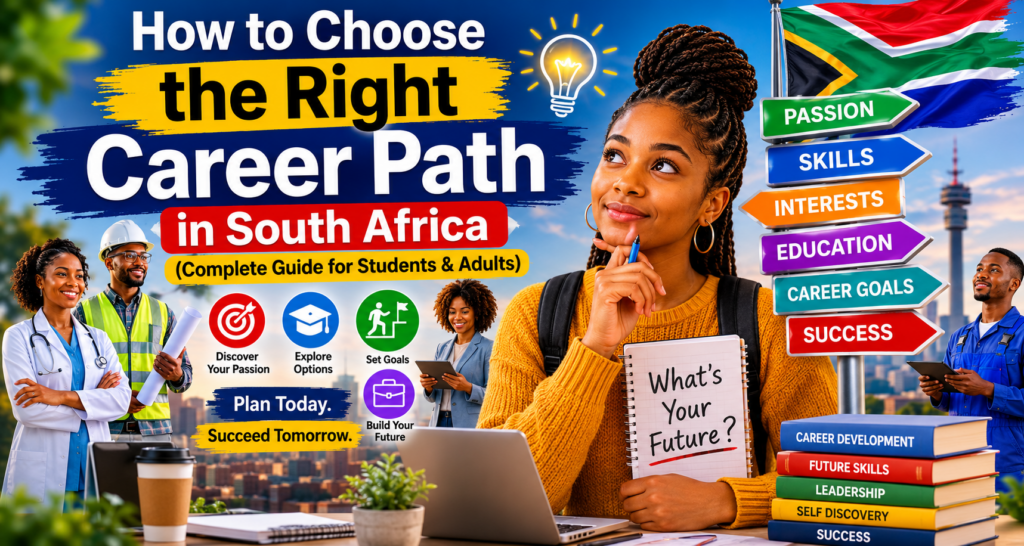

Choosing a career is one of the biggest decisions you’ll ever make. The path you choose can influence your income, lifestyle, personal satisfaction, and future opportunities for years to come.
Yet many South Africans find themselves feeling uncertain about what career to pursue. Some students leave school without a clear direction. Others complete qualifications only to discover they are unhappy in their chosen field. Many adults reach their thirties or forties and begin questioning whether they are still on the right path.
If that sounds familiar, you’re not alone.
The good news is that choosing the right career doesn’t have to be based on guesswork. With the right approach, you can identify careers that match your interests, strengths, personality, and long-term goals while also considering the realities of the South African job market.
Whether you’re a high school learner, university student, recent graduate, unemployed job seeker, or working professional looking for a fresh start, this guide will help you make informed decisions about your future.
In this comprehensive guide, you’ll learn:
- How to choose a career in South Africa that suits your strengths and interests
- Why self-assessment is critical before making career decisions
- Which careers are currently in demand in South Africa
- Common mistakes people make when selecting a career
- How to successfully change careers later in life
- Practical tools and strategies for making confident career decisions
Let’s begin by understanding why choosing the right career matters more than most people realize.
Table of Contents
- Why Choosing the Right Career Matters
- Understanding Yourself Before Choosing a Career
- How Personality Tests Can Help
- Identifying Your Skills, Strengths, and Interests
- Setting Long-Term Career Goals
- Best Career Paths in South Africa Right Now
- Careers That Are Growing in Demand
- Career Guidance for Students
- Career Guidance for Adults Looking for Change
- Practical Examples of Career Decision-Making
- Expert Insights on Career Planning
- Common Career Mistakes to Avoid
- How to Change Careers Later in Life
- Frequently Asked Questions
- Final Takeaway
Why Choosing the Right Career Matters

Many people think choosing a career is simply about finding a job that pays well. While salary is certainly important, a fulfilling career goes much deeper than a monthly paycheck.
The average person spends more than 80,000 hours working throughout their lifetime. That’s a significant portion of your life. Choosing a career that aligns with your interests, strengths, and values can lead to greater job satisfaction, better mental well-being, and stronger long-term financial growth.
On the other hand, selecting a career based solely on pressure from family, friends, or social expectations can lead to frustration, burnout, and costly career changes later in life.
Consider two individuals:
Person A chooses a career in accounting because relatives believe it offers stability and good income. Although successful on paper, they find the work repetitive and uninteresting.
Person B chooses a career in digital marketing because they enjoy creativity, technology, and communication. They begin with a lower salary but eventually excel because they genuinely enjoy what they do.
Who is more likely to stay motivated, develop new skills, and progress in their field?
In most cases, Person B.
This doesn’t mean passion alone should drive your decisions. The ideal career sits at the intersection of:
- What you enjoy
- What you’re good at
- What employers need
- What can provide sustainable income
Finding that balance is the foundation of smart career planning.
The Cost of Choosing the Wrong Career
A poor career choice can affect multiple areas of your life.
Financial Consequences
Changing qualifications, retraining, or switching industries often requires additional time and money. Some people spend years studying toward careers they eventually abandon.
Reduced Job Satisfaction
When your daily work doesn’t align with your strengths or interests, it becomes harder to stay engaged and motivated.
Limited Growth Opportunities
People tend to excel in fields that naturally suit their abilities. Choosing the wrong career can limit advancement opportunities and professional development.
Increased Stress and Burnout
Constant dissatisfaction at work can affect physical health, relationships, confidence, and overall quality of life.
This is why career planning deserves careful thought rather than rushed decision-making.
Understanding Yourself Before Choosing a Career
Before researching qualifications, universities, or job opportunities, you need to understand yourself.
Many career experts agree that self-awareness is the most important step in career planning.
Instead of asking:
“What job should I choose?”
Ask:
“What type of work would allow me to perform at my best and enjoy what I do?”
The answer starts with self-assessment.
What Is Self-Assessment?
Self-assessment is the process of evaluating your:
- Interests
- Personality traits
- Skills
- Values
- Strengths
- Weaknesses
- Career goals
Think of it as creating a personal blueprint before building your future.
Without self-assessment, career decisions often become guesses.
With self-assessment, career decisions become strategic.
Questions to Ask Yourself
Take a notebook and honestly answer the following questions:
Interests
- What subjects did I enjoy most in school?
- What topics do I read about for fun?
- What activities make me lose track of time?
- What problems do I enjoy solving?
Skills
- Am I good with numbers?
- Do I communicate well?
- Do I enjoy working with technology?
- Am I creative?
- Do I enjoy leading people?
Values
- Is job security important to me?
- Do I want flexibility and remote work?
- Do I prefer helping people?
- Is earning a high income a top priority?
- Do I want opportunities to travel?
Work Environment
- Do I prefer working alone or in teams?
- Do I enjoy office environments?
- Would I rather work outdoors?
- Do I enjoy hands-on practical work?
Your answers will begin revealing patterns that point toward suitable career options.
How Personality Tests Can Help
Personality assessments are not designed to choose a career for you.
Instead, they help identify environments and roles where you are most likely to succeed.
Many career counsellors use personality assessments as part of career guidance for students and adults because they provide valuable insights into work preferences.
Popular Career Personality Assessments
1. Holland Code (RIASEC)
This model groups people into six personality categories:
| Type | Description |
|---|---|
| Realistic | Practical, hands-on, technical |
| Investigative | Analytical, scientific, research-oriented |
| Artistic | Creative and expressive |
| Social | Helping, teaching, supporting others |
| Enterprising | Leadership, business, sales |
| Conventional | Organised, detail-focused, administrative |
Most people have a combination of two or three dominant traits.
For example:
A person who scores highly in Social and Investigative areas may enjoy:
- Nursing
- Psychology
- Education
- Healthcare
- Social Work
Someone who scores highly in Enterprising and Conventional traits may thrive in:
- Business Management
- Sales
- Entrepreneurship
- Banking
- Human Resources
2. Myers-Briggs Type Indicator (MBTI)
The MBTI identifies personality preferences related to:
- Introversion vs Extroversion
- Thinking vs Feeling
- Sensing vs Intuition
- Judging vs Perceiving
While not perfect, it can help people better understand their working style and communication preferences.
3. Career Aptitude Assessments
Many schools, colleges, and private career counsellors in South Africa offer aptitude assessments that measure:
- Verbal ability
- Numerical reasoning
- Problem-solving
- Spatial awareness
- Mechanical understanding
- Logical thinking
These assessments can highlight strengths you may not even realize you have.
Don’t Let Tests Make the Decision for You
One mistake many people make is treating personality tests as final answers.
A test might suggest careers in teaching, engineering, or business, but your interests, goals, and circumstances still matter.
Use personality tests as guidance tools, not instruction manuals.
The best career decisions combine:
- Self-awareness
- Research
- Practical experience
- Career guidance
- Market demand
Career Reflection Exercise
Before moving to the next section, spend 15 minutes completing this simple exercise.
Write down:
Three Activities You Enjoy
Example:
- Helping people solve problems
- Creating content online
- Working with computers
Three Skills You’re Good At
Example:
- Communication
- Organization
- Problem-solving
Three Things You Want From a Career
Example:
- Financial stability
- Growth opportunities
- Work-life balance
Now look for overlap.
These overlapping areas often reveal promising career directions.
For example:
Someone who enjoys technology, has strong analytical skills, and wants high earning potential may explore careers such as:
- Software Development
- Data Analysis
- Cybersecurity
- Information Technology
Someone who enjoys helping others and communicates well may consider:
- Teaching
- Nursing
- Counselling
- Human Resources
The clearer you become about who you are, the easier it becomes to identify the best career paths in South Africa that genuinely fit your future goals.
Identifying Your Strengths and Interests
One of the most effective ways to choose a career is to understand the difference between what you enjoy and what you do well.
Many people focus only on their interests. Others focus only on their skills. The most successful career choices usually combine both.
For example, someone may enjoy sports but possess strong analytical skills. Instead of becoming a professional athlete, they may thrive as a sports analyst, physiotherapist, sports marketer, or fitness entrepreneur.
The goal is to find careers that allow your interests and strengths to work together.
Understanding Your Strengths
Your strengths are activities or abilities that come naturally to you.
Ask yourself:
- What do people often compliment me on?
- What tasks do I complete easily while others struggle?
- Which school subjects did I perform best in?
- What responsibilities do friends, family, or colleagues trust me with?
Common strengths include:
| Strength | Potential Career Areas |
|---|---|
| Communication | Marketing, Teaching, Journalism, Public Relations |
| Leadership | Business Management, Project Management, Entrepreneurship |
| Creativity | Graphic Design, Content Creation, Advertising |
| Analytical Thinking | Engineering, Data Analysis, Finance |
| Problem Solving | IT, Cybersecurity, Consulting |
| Empathy | Nursing, Psychology, Social Work |
| Attention to Detail | Accounting, Administration, Auditing |
Understanding Your Interests
Interests reveal what motivates you.
When you genuinely enjoy your work, learning new skills and overcoming challenges becomes much easier.
Think about:
What Topics Excite You?
Do you enjoy:
- Technology?
- Business?
- Healthcare?
- Education?
- Construction?
- Finance?
- Creative arts?
What Content Do You Consume?
The videos, books, podcasts, and websites you regularly engage with often reveal your natural interests.
For example:
Someone who constantly watches videos about entrepreneurship may be suited for business-related careers.
Someone fascinated by technology trends may thrive in the IT industry.
The Career Overlap Formula
A useful formula is:
Interests + Skills + Market Demand = Strong Career Choice
Let’s look at a practical example.
| Category | Example |
| Interest | Technology |
| Strength | Problem-solving |
| Market Demand | Growing IT sector |
| Possible Careers | Software Developer, Cybersecurity Analyst, Data Analyst |
Another example:
| Category | Example |
| Interest | Helping people |
| Strength | Communication |
| Market Demand | Healthcare and education |
| Possible Careers | Teacher, Nurse, Counsellor, HR Professional |
When all three areas align, career decisions become much easier.
Setting Long-Term Career Goals
Many people choose careers based only on current circumstances.
A smarter approach is to think about where you want to be five, ten, or even twenty years from now.
Career planning is not just about your first job. It’s about your future lifestyle and opportunities.
Questions to Consider
Ask yourself:
Lifestyle Goals
- Do I want flexible working hours?
- Do I want remote work opportunities?
- Do I want to travel internationally?
- Do I want to run my own business someday?
Financial Goals
- What income level would I like to achieve?
- Do I want a career with strong earning potential?
- Am I willing to invest years in training for higher future rewards?
Personal Goals
- Do I enjoy continuous learning?
- Do I want to help communities?
- Do I enjoy leading teams?
- Do I prefer working independently?
These answers help narrow down suitable career paths.
Create a Career Vision Statement
Try writing a simple career vision.
Example:
“I want a career that combines technology, problem-solving, and good earning potential while allowing opportunities for remote work and international growth.”
This statement can help guide future decisions regarding qualifications, courses, and job opportunities.
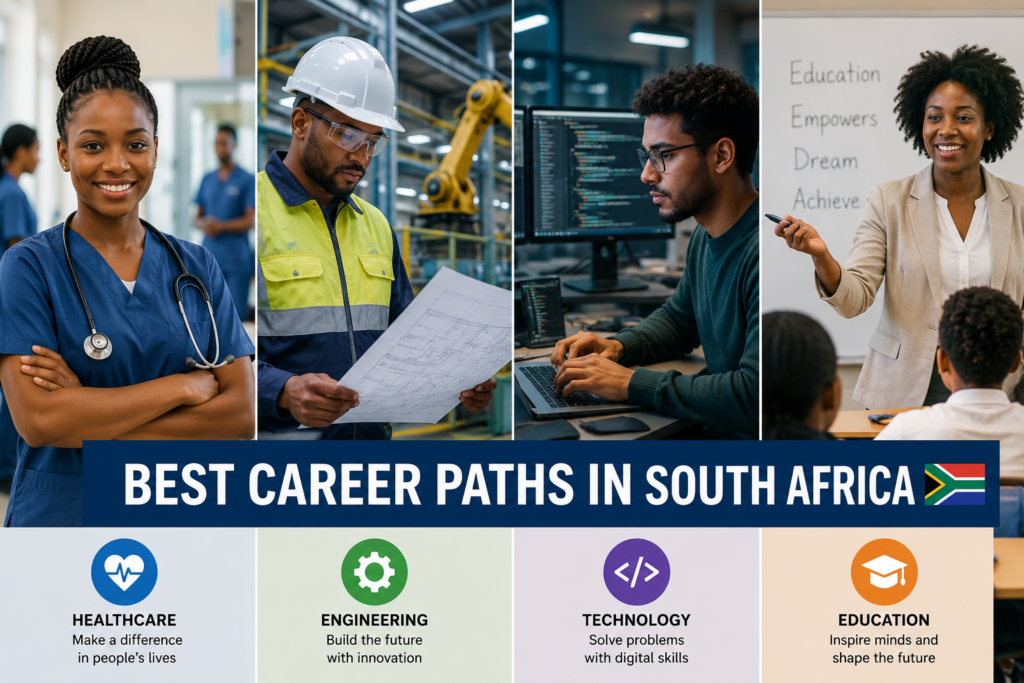
Best Career Paths in South Africa Right Now
One of the most common questions people ask is:
“Which careers are currently in demand in South Africa?”
While no career is guaranteed, certain industries continue to experience strong demand due to skills shortages, technological advancement, and economic development.
The best career paths in South Africa often combine:
- Strong demand
- Good salary potential
- Long-term growth opportunities
- Transferable skills
1. Information Technology (IT)
Technology continues to transform every industry.
Businesses increasingly require professionals who can manage systems, secure networks, analyze data, and develop software.
Popular IT Careers
- Software Developer
- Web Developer
- Data Analyst
- Cybersecurity Specialist
- Cloud Engineer
- IT Support Technician
- Artificial Intelligence Specialist
Why IT Is Growing
- Digital transformation
- Increased online business activity
- Cybersecurity threats
- Demand for remote workers globally
2. Healthcare Careers
Healthcare remains one of the most stable sectors worldwide.
South Africa continues to need qualified healthcare professionals in both public and private sectors.
Popular Healthcare Careers
- Nurse
- Medical Doctor
- Pharmacist
- Physiotherapist
- Occupational Therapist
- Radiographer
- Healthcare Administrator
Benefits
- Strong demand
- Job stability
- Opportunity to help others
- International career opportunities
3. Engineering
All Engineering fields remain one of the most respected and rewarding professions.
Engineering Fields
- Civil Engineering
- Mechanical Engineering
- Electrical Engineering
- Industrial Engineering
- Chemical Engineering
Engineers play a critical role in infrastructure, manufacturing, construction, and energy development.
4. Finance and Accounting
Businesses always need professionals who understand money, compliance, and financial planning.
Popular Careers
- Chartered Accountant
- Financial Analyst
- Auditor
- Tax Consultant
- Investment Advisor
- Risk Analyst
These careers often provide strong earning potential and career progression.
5. Education and Training
Education remains essential for national development.
South Africa continues to need skilled educators, trainers, and learning specialists.
Opportunities Include
- Teaching
- Online Education
- Corporate Training
- Educational Technology
- Curriculum Development
The rise of online learning has also created new opportunities for educators.
6. Skilled Trades
Not every successful career requires a university degree.
Many skilled trades are in demand and offer excellent income opportunities.
Examples
- Electrician
- Plumber
- Welder
- Boilermaker
- Automotive Technician
- Diesel Mechanic
These professions often face skills shortages and can provide entrepreneurial opportunities.
7. Business and Entrepreneurship
South Africa has a growing entrepreneurial ecosystem.
People with strong business skills can create opportunities for themselves and others.
Career Options
- Business Management
- Sales Management
- Marketing
- Digital Marketing
- E-commerce
- Entrepreneurship
Many successful business owners started with small side projects before building larger companies.
Career Guidance for Students
Students often feel pressure to make life-changing decisions before they fully understand the working world.
The truth is that very few people have everything figured out immediately after school.
If you’re a student, focus on exploration rather than perfection.
Practical Steps for Students
1. Research Career Options Early
Don’t wait until your final year of school.
Explore:
- Career websites
- University programs
- TVET College courses
- Industry reports
2. Speak to Professionals
Talk to people already working in careers that interest you.
Ask questions such as:
- What does a typical day look like?
- What qualifications are needed?
- What challenges exist?
3. Gain Experience
Look for:
- Job shadowing
- Volunteer opportunities
- Internships
- Part-time work
Real-world experience often provides more clarity than online research.
4. Develop Transferable Skills
Focus on:
- Communication
- Teamwork
- Problem-solving
- Leadership
- Digital literacy
These skills remain valuable regardless of your chosen career path.
Career Guidance for Adults Looking for Change
Many adults worry they are “too old” to change careers.
In reality, career changes are becoming increasingly common.
People switch careers because of:
- Better opportunities
- Industry changes
- Burnout
- New interests
- Technological disruption
The key is to view your existing experience as an asset rather than a limitation.
A salesperson may transition into digital marketing.
A teacher may move into corporate training.
An administrator may enter project management.
Career change does not mean starting from zero. It often means building on skills you already have.
Careers in Demand in South Africa
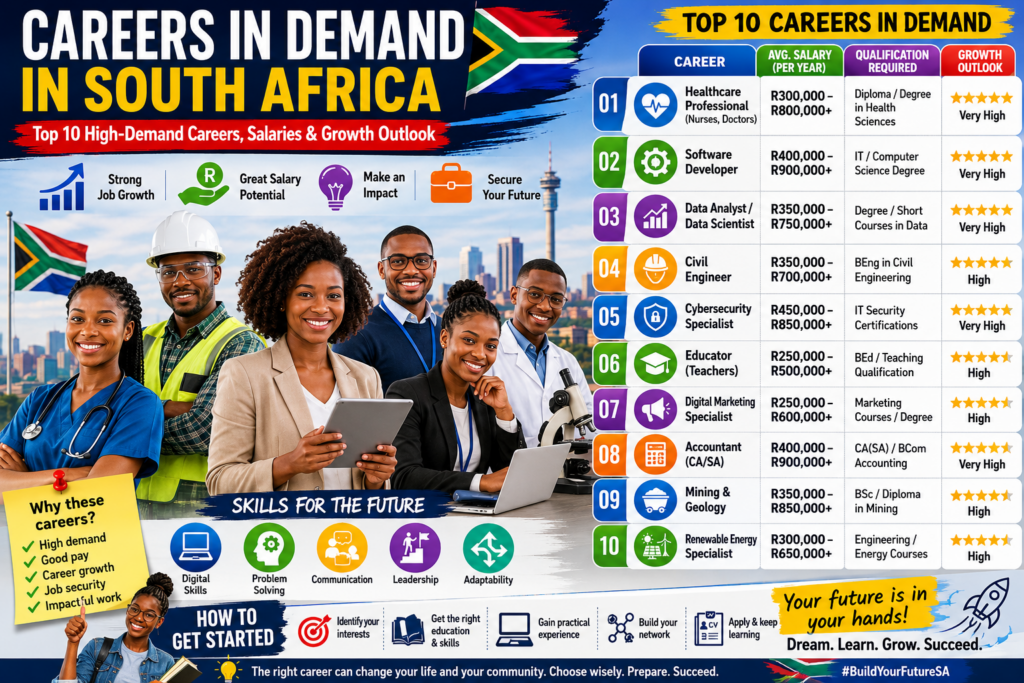
While personal interests and strengths should play a major role in career selection, understanding labour market trends can help you make informed decisions.
Choosing a career that aligns with both your abilities and market demand can improve your chances of finding employment and building a stable future.
Below are some of the sectors that continue to show strong demand for skilled professionals.
High-Demand Career Fields
| Industry | In-Demand Roles | Growth Potential |
|---|---|---|
| Information Technology | Software Developers, Data Analysts, Cybersecurity Specialists | High |
| Healthcare | Nurses, Doctors, Pharmacists, Therapists | High |
| Engineering | Civil, Mechanical, Electrical Engineers | High |
| Finance | Accountants, Auditors, Financial Analysts | High |
| Renewable Energy | Solar Technicians, Energy Engineers | Growing |
| Education | Teachers, Trainers, Educational Specialists | Stable |
| Logistics & Supply Chain | Supply Chain Managers, Procurement Specialists | Growing |
| Skilled Trades | Electricians, Plumbers, Welders | High |
| Digital Marketing | SEO Specialists, Content Creators, Social Media Managers | Growing |
| Entrepreneurship | Business Owners, E-commerce Specialists | Growing |
The workplace is evolving rapidly. Technology, automation, and global connectivity are creating new opportunities while changing traditional industries.
This is why lifelong learning has become one of the most important career skills anyone can develop.
Expert Insights: What Career Counsellors Recommend
Career professionals often notice a common pattern among people who are satisfied with their careers.
They usually do not choose a career based on a single factor.
Instead, they evaluate multiple areas before making a decision.
The Four-Part Career Decision Model
Experts often recommend balancing:
1. Interests
What do you genuinely enjoy?
2. Skills
What are you naturally good at?
3. Opportunities
Which industries are hiring?
4. Values
What matters most to you?
For example:
Someone who values flexibility may prioritize careers that allow remote work.
And also someone who values stability may prefer healthcare, education, or government-related professions.
Someone who values independence may be drawn toward entrepreneurship.
The most successful career decisions usually happen when all four areas align.
The Importance of Continuous Learning
A qualification alone is no longer enough.
Employers increasingly value people who:
- Learn new skills regularly
- Adapt to change
- Stay updated with industry developments
- Invest in professional development
Whether you’re entering the workforce or changing careers, continuous learning can help keep your skills relevant.
Examples include:
- Professional certifications
- Online courses
- Industry workshops
- Mentorship programs
- Professional networking events
The people who continue learning often create more opportunities for themselves over time.
Practical Career Decision Examples
Let’s look at some real-world scenarios that many South Africans can relate to.
Example 1: The High School Learner
Situation
Sipho is in Grade 11 and enjoys Mathematics and Physical Sciences.
Strengths
- Problem-solving
- Analytical thinking
- Attention to detail
Career Options
- Engineering
- Data Analysis
- Software Development
- Actuarial Science
Recommended Action
Research university requirements and speak to professionals working in these fields.
Example 2: The Graduate
Situation
Ayanda completed a business qualification but is unsure what career path to pursue.
Strengths
- Communication
- Organization
- Leadership
Career Options
- Human Resources
- Project Management
- Sales Management
- Marketing
Recommended Action
Gain workplace exposure through internships and graduate programmes.
Example 3: The Career Changer
Situation
Thabo has worked in retail for ten years but wants a higher-paying career.
Existing Skills
- Customer service
- Communication
- Team leadership
- Sales
Potential New Careers
- Digital Marketing
- Recruitment
- Account Management
- Customer Success Management
Recommended Action
Complete short online certifications while continuing current employment.
This approach reduces financial risk while building new skills.
Common Career Mistakes to Avoid
Even intelligent and hardworking people can make poor career decisions.
The good news is that most mistakes can be avoided with proper planning.
1. Choosing a Career Based Only on Salary
High salaries can be attractive, but money alone rarely leads to long-term satisfaction.
A career should also match your interests, strengths, and values.
2. Following Friends or Family Expectations
Parents, relatives, and friends often have good intentions.
However, their career preferences may not match your personality or goals.
Your career is something you will live with every day—not them.
3. Ignoring Labour Market Trends
Passion matters, but understanding market demand matters too.
Research industries before committing years to education and training.
4. Not Researching Career Requirements
Many people choose careers without understanding:
- Required qualifications
- Salary expectations
- Working conditions
- Career progression opportunities
Research can prevent disappointment later.
5. Believing One Decision Determines Your Entire Life
Many people change careers successfully.
Choosing a career today does not lock you into that path forever.
Careers evolve, industries change, and opportunities emerge.
6. Waiting for the “Perfect” Career
No career is perfect.
Every profession includes challenges.
The goal is not perfection.
The goal is finding a career that provides purpose, growth, and opportunities while aligning with your strengths.
How to Change Careers Later in Life
One of the biggest myths about career planning is that career changes are only for young people.
In reality, many professionals successfully change careers in their thirties, forties, fifties, and beyond.
Experience often becomes an advantage rather than a disadvantage.
Step 1: Identify Transferable Skills
Transferable skills are abilities that can be used across multiple industries.
Examples include:
- Leadership
- Communication
- Project management
- Problem-solving
- Customer service
- Teamwork
These skills remain valuable regardless of industry.
Step 2: Identify Skill Gaps
Determine what additional knowledge or qualifications may be required.
For example:
Someone moving into digital marketing may need:
- SEO knowledge
- Content marketing skills
- Social media marketing training
Fortunately, many of these skills can be learned online.
Step 3: Start Small
You do not always need to quit your current job immediately.
Consider:
- Freelancing
- Part-time work
- Online courses
- Volunteer opportunities
- Side projects
These options allow you to gain experience while minimizing financial risk.
Step 4: Build a Professional Network
Networking remains one of the most effective ways to discover opportunities.
Attend:
- Industry events
- Career expos
- Professional association meetings
- Online networking communities
Relationships often open doors that qualifications alone cannot.
Step 5: Be Patient
Career transitions take time.
Focus on steady progress rather than immediate results.
Many successful professionals spent months or years building toward a new career before making the full transition.
Career Success Checklist
Before making your final career decision, ask yourself:
– Does this career align with my interests?
– Are my strengths matched?
– Does it support my long-term goals?
– Is there demand for these skills?
– Have I researched the industry properly?
– Have I spoken to professionals in the field?
– Do I understand the qualifications required?
– Am I willing to continue learning and developing?
If you answered “yes” to most of these questions, you’re likely moving in the right direction.
Frequently Asked Questions (FAQs)

1. How do I choose a career if I have many interests?
It’s common to have multiple interests, especially when you’re young or exploring new opportunities. Start by identifying which interests align with your strongest skills and offer realistic career opportunities. You can also gain experience through volunteering, internships, or job shadowing to determine which field feels like the best fit.
2. What is the best career path in South Africa?
There is no single “best” career for everyone. The best career path depends on your interests, abilities, values, and goals. However, careers in Information Technology, Healthcare, Engineering, Finance, Skilled Trades, Renewable Energy, and Digital Marketing continue to show strong demand in South Africa.
3. Can I change careers later in life?
Absolutely. Many people successfully change careers in their 30s, 40s, 50s, and beyond. The key is identifying transferable skills, gaining any necessary training, and creating a practical transition plan.
4. Are personality tests accurate for career planning?
Personality tests can be useful tools for self-discovery, but they should not be the only factor influencing your career decisions. Use them alongside career research, practical experience, and professional guidance.
5. What if I choose the wrong career?
Career decisions are not permanent. Many professionals change industries or specialize in different areas during their working lives. If you discover a career is not right for you, you can reassess your goals and explore alternative paths.
6. Do I need a university degree to have a successful career?
No. While some careers require degrees, many successful professionals build rewarding careers through TVET qualifications, apprenticeships, certifications, entrepreneurship, and practical work experience.
Examples include:
- Electricians
- Plumbers
- Web Developers
- Digital Marketers
- Entrepreneurs
- Sales Professionals
Skills and experience are often just as valuable as formal qualifications.
7. How can students gain career experience before graduating?
Students can gain valuable exposure through:
- Internships
- Learnerships
- Volunteer work
- Part-time jobs
- Job shadowing
- Student leadership programs
Practical experience helps students make more informed career decisions and improves employability.
8. What careers are expected to grow in the future?
Several industries are expected to continue growing over the coming years, including:
- Artificial Intelligence
- Cybersecurity
- Data Analytics
- Renewable Energy
- Healthcare
- Software Development
- Digital Marketing
- E-commerce
- Logistics and Supply Chain Management
These sectors are being driven by technological advancement and changing business needs.
9. Where can I get career guidance in South Africa?
You can seek career guidance from:
- School career counsellors
- Universities and colleges
- TVET institutions
- Professional career coaches
- Industry associations
- Government education and employment resources
Career guidance can help you understand your strengths, explore opportunities, and make informed decisions.
Conclusion
Choosing a career is one of the most important investments you can make in your future. It influences not only your earning potential but also your daily happiness, personal growth, and long-term opportunities.
The process of choosing a career should never be rushed.
Take time to understand yourself, identify your strengths, explore your interests, and research industries that align with your goals. Speak to professionals, gain practical experience where possible, and remain open to learning throughout your journey.
Remember that careers are rarely linear. Many successful people changed direction, learned new skills, and adapted to new opportunities along the way.
The most important thing is not finding a perfect career.
It’s finding a career that allows you to grow, contribute, earn a living, and build a future that reflects your values and ambitions.
Whether you’re a student choosing your first path, a graduate entering the workforce, or an adult considering a fresh start, the right career decision begins with self-awareness and informed planning.
Your future career starts with the choices you make today.
Final Takeaway
If you’re wondering how to choose a career in South Africa, focus on four key areas:
Know Yourself
Understand your interests, strengths, personality, and values.
Research Your Options
Learn about industries, qualifications, and employment trends.
Gain Real-World Experience
Seek internships, volunteering opportunities, job shadowing, and mentorship.
Stay Adaptable
The future of work is changing. Commit to lifelong learning and continuous improvement.
The people who succeed are not always the ones who choose the “perfect” career first.
They are often the people who continue learning, growing, and adapting throughout their careers.
Start where you are, use the resources available to you, and take the next step toward building a career that matches both your potential and your ambitions.
Authority Sources
South African Government Resources
- Department of Higher Education and Training (DHET)
- South African Government Careers Portal
- National Student Financial Aid Scheme (NSFAS)
Educational Institutions
- University of South Africa (UNISA)
- University of Cape Town
- University of Pretoria
Industry & Research Authorities
- Statistics South Africa
- South African Qualifications Authority (SAQA)
- Human Sciences Research Council (HSRC)
Professional Associations
- Engineering Council of South Africa (ECSA)
- Health Professions Council of South Africa (HPCSA)
- South African Institute of Chartered Accountants (SAICA)
Also Read:
50 Common Job Interview Questions and Answers in South Africa
How to Write a Winning CV in South Africa
30 High-Paying Careers in South Africa and Their Salary Expectations
How to Get Your First Job With No Experience in South Africa