
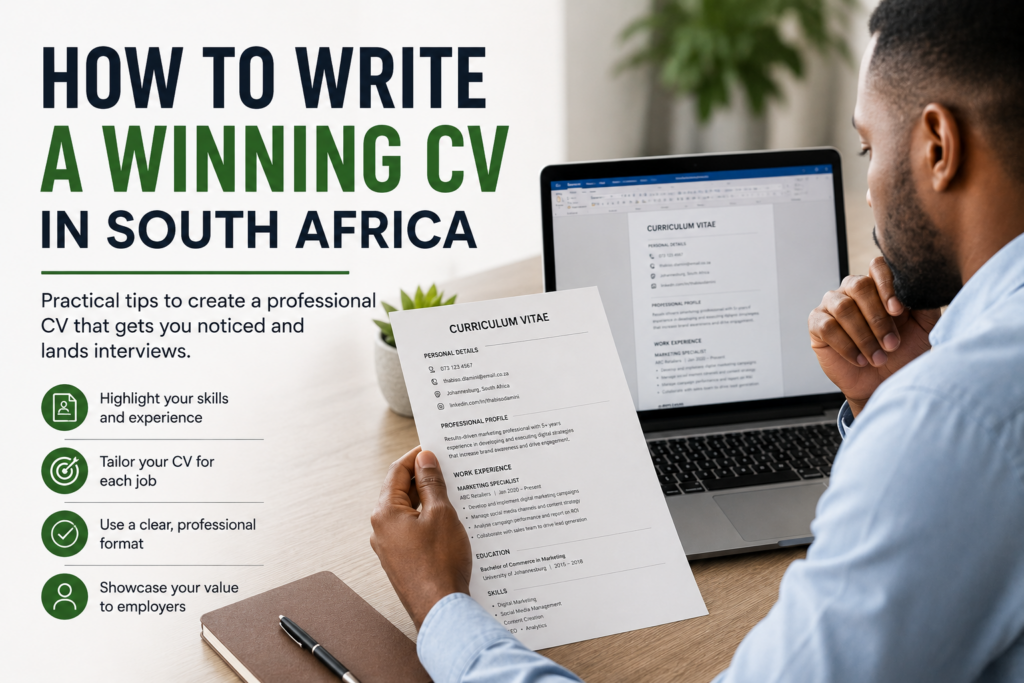
How to Write a Winning CV in South Africa

Finding a job in South Africa can be challenging, especially when hundreds of applicants compete for the same opportunity. Whether you’re applying for your first job, an internship, a learnership, a graduate programme, or a senior position, your CV is often the first impression you make on a potential employer.
Many job seekers spend hours searching for vacancies but only a few minutes updating their CV. Unfortunately, even highly qualified candidates can miss out on opportunities simply because their CV fails to showcase their skills, experience, and value effectively.
The reality is that recruiters often spend less than a minute scanning a CV before deciding whether a candidate should move to the next stage of the recruitment process.
That means your CV needs to grab attention quickly.
A well-written CV can open doors to interviews, while a poorly structured one may prevent employers from ever discovering your potential.
The good news is that writing a professional CV is a skill that anyone can learn.
In this complete guide, you’ll discover how to write a winning CV in South Africa, what information employers expect to see, common mistakes to avoid, and practical strategies that can significantly improve your chances of getting shortlisted.
Whether you’re a student, graduate, unemployed job seeker, or experienced professional, these tips will help you create a CV that stands out in a competitive job market.
Table of Contents
- Why Your CV Matters
- What Employers Look For in a CV
- The Ideal CV Structure
- Personal Information Section
- Professional Summary Section
- Education Section
- Work Experience Section
- Skills Section
- References Section
- CV Formatting Tips
- Common CV Mistakes to Avoid
- CV Examples for South Africans
- Expert CV Writing Tips
- Frequently Asked Questions
- Final Takeaway
Why Your CV Matters
Your CV is more than a document.
It is your personal marketing tool.
Employers use your CV to determine:
- Whether you meet the minimum requirements
- Whether your experience matches the role
- Whether you have the necessary skills
- Whether you are worth inviting for an interview
Think of your CV as your personal advertisement.
Just as businesses market products to customers, your CV markets your skills and experience to employers.
A strong CV can help you:
- Get more interviews
- Stand out from other applicants
- Demonstrate professionalism
- Showcase your achievements
- Increase your chances of employment
A weak CV, however, can prevent opportunities before you even get the chance to speak to an employer.
This is why learning how to write a winning CV in South Africa is one of the most valuable career skills you can develop.
What Employers Look For in a CV
Recruiters are usually searching for specific information.
They want to know:
Can you do the job?
Your qualifications, skills, and experience should clearly demonstrate your ability to perform the role.
Are you professional?
A clean, organized CV shows attention to detail and professionalism.
Do you meet the requirements?
Employers often compare CVs directly against the job description.
What makes you different?
Your achievements and accomplishments help you stand out from other applicants.
Before writing your CV, always review the job advertisement carefully and identify the qualities the employer is looking for.
Your CV should be tailored to match those requirements wherever possible.
The Ideal CV Structure

One of the biggest mistakes job seekers make is using a CV format that is difficult to read.
Recruiters often review dozens or even hundreds of applications. A cluttered or poorly organized CV can quickly end up in the rejection pile, regardless of your qualifications.
A professional South African CV should generally contain the following sections:
- Personal Information
- Professional Summary
- Education and Qualifications
- Work Experience
- Skills
- Certifications and Training (if applicable)
- References
This structure is easy for recruiters to follow and ensures they can quickly find the information they need.
Personal Information Section
The personal information section should appear at the top of your CV.
This section provides employers with the details they need to contact you.
Include:
- Full Name
- Contact Number
- Email Address
- City and Province
- LinkedIn Profile (Optional)
- Driver’s Licence (If Relevant)
Example
Sandile Mdluli
Johannesburg, Gauteng
082 123 4567
LinkedIn: linkedin.com/in/sandilemdluli
Code B Driver’s Licence
Avoid Including:
- Marital Status
- Religion
- Race
- Political Views
- Health Information
- Unnecessary Personal Details
Most employers do not require this information and including it can make your CV appear outdated.
Should You Include a Photo on Your CV?
This is one of the most common questions among South African job seekers.
In most industries, a photo is not necessary.
The only exceptions may include:
- Modelling
- Acting
- Media-related roles
- Brand ambassador positions
For most jobs, a professional CV without a photo is perfectly acceptable.
Creating a Strong Professional Summary
Your professional summary is one of the most important parts of your CV.
It appears near the top of the document and provides recruiters with a quick overview of who you are.
Think of it as your elevator pitch.
In just a few sentences, explain:
- Who you are
- Your experience
- Your key skills
- What value you bring
Example Professional Summary for a Student
Motivated and hardworking student seeking an entry-level opportunity to apply academic knowledge and develop professional skills. Strong communication, teamwork, and problem-solving abilities with a willingness to learn and grow within a professional environment.
Example Professional Summary for a Graduate
Recent Business Management graduate with strong organizational, communication, and analytical skills. Eager to contribute to a dynamic organization while developing practical industry experience and supporting business objectives.
Example Professional Summary for an Experienced Professional
Experienced Administrative Officer with more than five years of experience supporting business operations, managing records, and coordinating office activities. Proven ability to improve efficiency, maintain accuracy, and deliver excellent service in fast-paced environments.
Tips for Writing a Strong Summary
Keep It Short
Aim for 3 to 5 sentences.
Focus on Value
Explain how you can help the employer.
Tailor It
Adjust your summary for each application where possible.
Include Relevant Keywords
Use words that appear in the job advertisement.
This can help your CV perform better when employers use Applicant Tracking Systems (ATS).
Education and Qualifications Section
Your education section demonstrates your academic background and qualifications.
The placement of this section depends on your experience level.
Students and Graduates
Place education near the top of your CV.
Experienced Professionals
Place work experience before education.
What to Include
For each qualification, list:
- Qualification Name
- Institution Name
- Completion Date
- Major Subjects (Optional)
- Achievements (Optional)
Example
Diploma in Human Resource Management
Durban University of Technology
Completed: 2025
Key Subjects:
- Labour Relations
- Human Resource Development
- Employment Law
- Organisational Behaviour
Example for Matric Candidates
National Senior Certificate (Matric)
ABC Secondary School
Completed: 2024
Subjects:
- English
- Mathematics
- Life Sciences
- Business Studies
- Accounting
- Life Orientation
Include Additional Training
Many South African employers value practical skills and certifications.
Examples include:
- Health and Safety Courses
- First Aid Training
- Computer Courses
- Microsoft Office Certifications
- Digital Marketing Certifications
- Welding Certifications
- Driver Training
- Customer Service Training
Additional certifications can strengthen your application and demonstrate initiative.
What If You Don’t Have Formal Qualifications?
Many employers also value:
- Learnerships
- Short Courses
- Online Certifications
- Apprenticeships
- Volunteer Experience
- Practical Skills
Don’t underestimate the value of these achievements.
Skills and experience often matter just as much as formal education.
Quick CV Tip
Always list your most recent qualification first.
Recruiters want to see your latest achievements immediately.
For example:
Diploma (2025)
Certificate (2023)
Matric (2021)
This is known as reverse chronological order and is the preferred format used by most employers and recruiters.
Why Education Still Matters
Even if a position does not require a degree, employers often view education as evidence of:
- Commitment
- Discipline
- Time management
- Ability to learn
This is why your education section should always be presented clearly and professionally.
A well-structured education section helps recruiters quickly determine whether you meet the requirements for the role and can significantly improve your chances of progressing to the interview stage.
Writing an Effective Work Experience Section

For many recruiters, the work experience section is the most important part of a CV.
This section helps employers understand:
- What roles you’ve held
- What responsibilities you’ve managed
- What skills you’ve developed
- What results you’ve achieved
A common mistake job seekers make is simply listing job duties.
Instead, focus on demonstrating value and accomplishments.
What to Include
For each position, include:
- Job Title
- Company Name
- Employment Dates
- Key Responsibilities
- Achievements
Example Work Experience Entry
Administrative Assistant
ABC Logistics (Pty) Ltd
January 2023 – Present
Responsibilities:
- Managed office correspondence and filing systems
- Scheduled meetings and maintained calendars
- Prepared reports and presentations
- Assisted with customer inquiries and support
Achievements:
- Improved document organization system, reducing file retrieval time
- Assisted in implementing a digital filing process
- Consistently met deadlines in a fast-paced environment
Use Action Words
Strong action words make your CV more professional.
Examples include:
- Managed
- Coordinated
- Implemented
- Developed
- Improved
- Assisted
- Led
- Organized
- Maintained
- Supervised
Compare these examples:
❌ Responsible for customer service.
✅ Assisted customers daily and resolved service-related issues efficiently.
The second example sounds stronger and demonstrates impact.
How to Write Work Experience with No Formal Employment
Many South Africans struggle because they have little or no formal work experience.
The good news is that experience comes in many forms.
You can include:
Volunteer Work
Example:
Volunteer – Community Food Programme
Internships
Example:
Administrative Intern – XYZ Company
Learnerships
Example:
Business Administration Learnership
Apprenticeships
Example:
Electrical Apprentice
Freelance Work
Example:
Freelance Graphic Designer
Self-Employment
Example:
Independent Welder and Fabricator
The key is demonstrating skills, responsibilities, and achievements.
Example for a First-Time Job Seeker
Community Volunteer
Local Community Development Project
2024 – 2025
Responsibilities:
- Assisted with organizing community events
- Worked with team members to support local initiatives
- Helped manage attendance records and event logistics
Skills Developed:
- Teamwork
- Communication
- Organization
- Problem-solving
This experience can still add value to your CV.
The Skills Section
The skills section helps recruiters quickly identify your strengths.
Many companies now use Applicant Tracking Systems (ATS) that scan CVs for relevant keywords.
Including relevant skills can improve your chances of being shortlisted.
Types of Skills to Include
Hard Skills
These are technical or job-specific skills.
Examples:
- Microsoft Word
- Microsoft Excel
- Data Entry
- Welding
- Accounting
- Digital Marketing
- Coding
- Project Management
- Forklift Operation
- Graphic Design
Soft Skills
These are personal and workplace skills.
Examples:
- Communication
- Teamwork
- Leadership
- Time Management
- Adaptability
- Customer Service
- Problem-Solving
- Attention to Detail
- Conflict Resolution
Example Skills Section
Professional Skills
- Microsoft Office Suite
- Customer Service
- Data Capture
- Team Collaboration
- Problem-Solving
- Report Writing
- Time Management
- Communication Skills
Tailor Skills to the Job
One of the easiest ways to improve your CV is by adjusting your skills section to match the vacancy.
For example:
If the job advert mentions:
- Customer service
- Communication
- Teamwork
Then ensure those skills appear on your CV if they genuinely apply to you.
The References Section
References provide employers with people they can contact to verify your work history, character, and performance.
What to Include
For each reference:
- Full Name
- Position
- Company
- Contact Number
- Email Address
Example
John Smith
Operations Manager
ABC Logistics
082 123 4567
How Many References Should You Include?
Generally, two to three professional references are sufficient.
Good references include:
- Previous managers
- Supervisors
- Team leaders
- Lecturers
- Mentors
Can You Write “References Available Upon Request”?
Yes.
Many modern CVs simply state:
References Available Upon Request
This saves space and allows you to provide references when requested.
CV Formatting Tips That Make a Huge Difference
Even great content can be overlooked if your CV is poorly formatted.
A professional layout improves readability and creates a stronger first impression.
Use a Professional Font
Recommended fonts include:
- Arial
- Calibri
- Helvetica
- Verdana
Font size:
- Headings: 12–14
- Body Text: 10–12
Keep It Clean
Use:
- Clear headings
- Consistent spacing
- Bullet points
- Professional formatting
Avoid:
- Bright colours
- Decorative fonts
- Excessive graphics
- Unnecessary design elements
Use Reverse Chronological Order
Always list:
- Most recent jobs first
- Most recent qualifications first
Recruiters want to see your latest achievements immediately.
Save as PDF
Before submitting your CV:
Save it as a PDF.
Benefits include:
- Preserves formatting
- Looks professional
- Opens correctly on different devices
How Long Should a CV Be?
This is one of the most common questions among job seekers.
Students and Graduates
1–2 pages
Mid-Level Professionals
2–3 pages
Senior Professionals
3–4 pages maximum
Avoid making your CV unnecessarily long.
Employers prefer concise and relevant information.
ATS-Friendly CV Tips
Many large employers use Applicant Tracking Systems (ATS) to screen applications before a human recruiter sees them.
To improve ATS compatibility:
Use standard headings
✅ Include keywords from the job advert
Avoid graphics and tables
✅ Use simple formatting
Save as PDF when appropriate
❌ Avoid placing important information inside images
Avoid unusual fonts
❌ Avoid complicated layouts
A simple CV often performs better than an overly designed one.
Quick CV Checklist Before Sending
Before applying for any job, ask yourself:
✅ Is my contact information correct?
Is my CV free from spelling mistakes?
✅ Have I tailored it to the job?
Have I included relevant skills?
✅ Is my work experience clearly explained?
Is the formatting professional?
✅ Have I saved it as a PDF?
If you can answer yes to all of these questions, your CV is likely ready for submission.
Common CV Mistakes to Avoid

Even highly qualified candidates can lose opportunities because of simple CV mistakes.
Recruiters often review dozens of applications in a short period. Small errors can create a negative impression and reduce your chances of being shortlisted.
Here are some of the most common mistakes job seekers make.
Using a Generic CV for Every Job
Many applicants send the same CV to every employer.
This is a mistake.
Each vacancy has different requirements.
Take time to customize your:
- Professional summary
- Skills section
- Work experience descriptions
A tailored CV demonstrates effort and improves relevance.
Spelling and Grammar Errors
A CV filled with spelling mistakes can suggest carelessness.
Before submitting your CV:
- Proofread carefully
- Use spelling and grammar tools
- Ask someone else to review it
Even a single mistake can affect a recruiter’s perception.
Including Too Much Information
Recruiters do not need your entire life story.
Avoid:
- Long paragraphs
- Irrelevant hobbies
- Outdated information
- Unnecessary personal details
Focus on information that supports your application.
Lying on Your CV
Never exaggerate qualifications, experience, or achievements.
Many employers verify:
- Qualifications
- Employment history
- References
Honesty builds credibility and trust.
Poor Formatting
Messy formatting makes your CV difficult to read.
Avoid:
- Multiple font styles
- Bright colours
- Inconsistent spacing
- Overly complex layouts
Simple and professional is always best.
Missing Contact Information
It may sound obvious, but many candidates forget to update:
- Phone numbers
- Email addresses
- Physical location
Always double-check your contact details before applying.
Example CV Template for South African Job Seekers
Below is a simple structure that works well for most industries.
Personal Information
Full Name
Contact Number
Email Address
City and Province
Driver’s Licence (Optional)
Professional Summary
A brief paragraph highlighting your experience, skills, and career objectives.
Education
Qualification Name
Institution
Completion Date
Relevant Subjects (Optional)
Work Experience
Job Title
Company Name
Employment Dates
Key Responsibilities
Achievements
Skills
Technical Skills
Soft Skills
Industry-Specific Skills
Certifications
Relevant Courses
Professional Training
Industry Certifications
References
References Available Upon Request
Expert CV Writing Advice
Recruiters and hiring managers often agree on one thing:
A winning CV is not necessarily the longest or most impressive.
It is the clearest.
Your goal is to make it easy for employers to answer one question:
“Can this person do the job?”
Everything on your CV should support that answer.
Focus on Achievements
Instead of listing duties, show results.
For example:
❌ Managed customer inquiries.
✅ Assisted more than 50 customers daily while maintaining high satisfaction levels.
Achievements make your experience more meaningful.
Use Numbers Where Possible
Numbers help demonstrate impact.
Examples:
- Trained 10 new employees
- Managed inventory worth R500,000
- Increased sales by 15%
- Assisted 60 customers daily
Specific figures make your accomplishments more credible.
Keep Learning
Adding new skills and certifications can strengthen your CV over time.
Consider learning:
- Microsoft Excel
- Project Management
- Digital Marketing
- Customer Service
- Health and Safety
- Data Analysis
Continuous learning demonstrates initiative and adaptability.
Frequently Asked Questions
1. How many pages should a CV be?
Students and graduates should generally keep their CV between one and two pages.
Experienced professionals may use two to three pages if necessary.
2. Should I include references on my CV?
You can either include two or three references or simply write:
References Available Upon Request
Both options are widely accepted.
3. Should I include my ID number on my CV?
In most cases, it is not necessary to include your full ID number.
Providing your age or date of birth is also usually unnecessary unless specifically requested.
4. Should I include hobbies and interests?
Only include hobbies if they are relevant or help demonstrate useful skills.
For example:
- Community volunteering
- Sports leadership
- Public speaking
5. Can I use the same CV for every job application?
No.
Tailoring your CV for each vacancy significantly improves your chances of success.
6. What file format should I use?
PDF is usually the preferred format because it preserves formatting across different devices.
7. How often should I update my CV?
Update your CV whenever you:
- Gain new experience
- Complete training
- Earn certifications
- Change jobs
- Develop new skills
8. What if I have no work experience?
Include:
- Volunteer work
- Learnerships
- Internships
- School projects
- Community involvement
- Freelance work
Employers understand that everyone starts somewhere.
9. Should I include a cover letter?
Yes, whenever possible.
A strong cover letter can complement your CV and help explain why you’re suitable for the position.
10. What is the most important part of a CV?
The most important sections are:
- Professional Summary
- Work Experience
- Skills
These are often reviewed first by recruiters.
Conclusion
Your CV is one of the most important tools in your job search.
It serves as your personal marketing document and often determines whether you are invited for an interview.
A winning CV is clear, professional, relevant, and tailored to the position you are applying for.
By focusing on strong formatting, relevant skills, measurable achievements, and accurate information, you can create a document that effectively showcases your value to employers.
Remember that your CV is not a one-time project.
It should evolve as your career grows.
Continue updating it with new qualifications, certifications, achievements, and experiences to ensure it remains competitive in today’s job market.
Final Takeaway
If you want to write a winning CV in South Africa, remember these key principles:
✅ Keep it professional
Keep it relevant
✅ Focus on achievements
Tailor it to each job
✅ Use clear formatting
Highlight your skills
✅ Proofread carefully
Keep learning and updating your experience
A well-written CV will not guarantee a job, but it can dramatically improve your chances of getting interviews and opening doors to new opportunities.
Invest the time to create a professional CV today, and you’ll be giving yourself a stronger chance of career success tomorrow.
Also Read:
How to Choose the Right Career Path in South Africa (For Students and Adults)
50 Common Job Interview Questions and Answers in South Africa