
50 Common Job Interview Questions and Answers in South Africa (Complete Guide for 2026)

Job interviews can be stressful, whether you’re applying for your first job, looking for a promotion, or changing careers.
Many South African job seekers spend hours searching for vacancies and perfecting their CVs, only to struggle when they finally get called for an interview. The truth is that employers are not only interested in your qualifications and experience. They also want to understand your personality, communication skills, problem-solving ability, work ethic, and whether you’ll fit into their team.
The good news is that most interview questions follow predictable patterns.
Once you understand why interviewers ask certain questions and learn how to structure your answers, you’ll feel more confident and perform much better during interviews.
In this comprehensive guide, you’ll discover 50 of the most common job interview questions and answers in South Africa, along with expert advice, practical examples, and proven techniques that can help you stand out from other candidates.
Whether you’re applying for a government position, learnership, internship, graduate programme, retail job, call centre role, administrative position, or professional career opportunity, this guide will help you prepare effectively.
Table of Contents
- How South African Job Interviews Work
- Interview Preparation Tips
- Personal Interview Questions
- Work Experience Questions
- Behavioural Interview Questions
- Teamwork and Communication Questions
- Problem-Solving Questions
- Leadership Questions
- Salary and Career Goals Questions
- Questions for Students and Graduates
- The 50 Most Common Interview Questions and Answers
- Expert Interview Tips
- Common Interview Mistakes to Avoid
- Frequently Asked Questions
- Final Takeaway
Why Interview Preparation Matters
Many candidates assume that interviews are simply conversations.
In reality, interviews are assessments.
Employers use interviews to determine:
- Whether you have the skills required
- How well you communicate
- How you handle pressure
- Whether you can work with others
- How motivated you are
- Whether you fit the company culture
A candidate with average experience but excellent interview preparation will often outperform a more experienced candidate who arrives unprepared.
That’s why practicing common interview questions can dramatically increase your chances of getting hired.
How South African Job Interviews Work
Although every company has its own recruitment process, most interviews in South Africa follow a similar structure.
Stage 1: Introduction
The interviewer introduces themselves and explains the position.
Stage 2: Personal Questions
Questions about your background, education, and experience.
Stage 3: Competency Questions
Questions designed to evaluate specific workplace skills.
Stage 4: Behavioural Questions
Questions about how you’ve handled situations in the past.
Stage 5: Candidate Questions
You are usually given an opportunity to ask questions about the role or company.
Stage 6: Closing
The interviewer explains the next steps in the recruitment process.
Understanding this structure helps reduce anxiety and allows you to prepare effectively.
Interview Preparation Tips Before You Attend Any Interview

Before we get into the actual questions, it’s important to understand that great interview performance starts long before you walk into the interview room.
Many candidates lose opportunities because they focus only on their CV and neglect interview preparation.
Use these proven preparation strategies before every interview.
Research the Company
Spend at least 30 minutes learning about:
- The company’s products or services
- Their mission and values
- Recent news and developments
- Their customers and target market
Interviewers are often impressed when candidates demonstrate knowledge about the organization.
Review the Job Description
Carefully study the vacancy advertisement.
Identify:
- Required skills
- Qualifications
- Responsibilities
- Experience requirements
Prepare examples from your background that match these requirements.
Practice Your Answers
You don’t need to memorize answers word for word.
Instead, practice explaining:
- Your experience
- Your achievements
- Your strengths
- Your career goals
The more comfortable you become discussing your background, the more confident you’ll sound.
Prepare Your Documents
Bring:
- Multiple copies of your CV
- Certified qualifications (if requested)
- Identification document
- Reference letters
- Portfolio (if applicable)
Dress Professionally
Even if the workplace has a casual environment, first impressions matter.
Aim for:
- Clean clothing
- Neat grooming
- Professional appearance
- Good posture
The 50 Most Common Job Interview Questions and Answers
Personal Interview Questions
These questions help employers understand who you are and how you present yourself professionally.
Question 1: Tell Me About Yourself
Why Employers Ask This
They want a brief professional summary, not your entire life story.
Sample Answer
“I recently completed a Diploma in Business Management and have gained experience through internships and part-time customer service roles. Throughout my studies, I developed strong communication, teamwork, and organizational skills. I’m now looking for an opportunity where I can contribute to a professional team while continuing to grow my career.”
Pro Tip
Focus on:
- Education
- Experience
- Relevant skills
- Career goals
Keep your answer between 60 and 90 seconds.
Question 2: Why Do You Want to Work Here?
Sample Answer
“I want to work here because your company has a strong reputation for excellence and professional development. After researching the organization, I was particularly impressed by your commitment to customer service and innovation. I believe my skills and experience align well with the position, and I’m excited about the opportunity to contribute.”
Question 3: What Do You Know About Our Company?
Sample Answer
“I understand that your company specializes in providing financial services across South Africa and has built a strong reputation for customer satisfaction. I also noticed your recent expansion into digital services, which shows a commitment to innovation and growth.”
Pro Tip
Always research the company before the interview.
Question 4: What Are Your Greatest Strengths?
Sample Answer
“One of my greatest strengths is problem-solving. I enjoy finding solutions when challenges arise and remain calm under pressure. I also have strong communication skills, which help me work effectively with both colleagues and customers.”
Question 5: What Is Your Biggest Weakness?
Sample Answer
“In the past, I sometimes spent too much time trying to perfect my work. While attention to detail is important, I’ve learned to balance quality with efficiency by setting clear priorities and deadlines.”
Avoid
Never say:
- “I don’t have any weaknesses.”
- “I’m always late.”
- “I struggle with teamwork.”
Choose a real weakness and explain how you’re improving it.
Question 6: Why Should We Hire You?
Sample Answer
“I believe I would be a valuable addition to your team because I combine strong technical skills with a positive attitude and willingness to learn. I work well with others, adapt quickly to new situations, and always strive to deliver high-quality results.”
Question 7: Where Do You See Yourself in Five Years?
Sample Answer
“In five years, I’d like to have developed my skills significantly, taken on greater responsibilities, and become a trusted contributor within the organization. I’m also interested in continuous learning and professional growth.”
Question 8: What Motivates You?
Sample Answer
“I’m motivated by achieving goals, learning new skills, and making a meaningful contribution to the team. I enjoy challenging myself and seeing the results of my efforts.”
Question 9: How Would Your Previous Manager Describe You?
Sample Answer
“I believe my previous manager would describe me as reliable, hardworking, and professional. I consistently met deadlines, maintained a positive attitude, and worked well with colleagues.”
Question 10: What Are Your Career Goals?
Sample Answer
“My goal is to build a successful long-term career in this industry while continuously developing my skills. I hope to take on increasing responsibilities and contribute meaningfully to organizational success.”
Work Experience Questions
These questions help employers evaluate your professional experience and workplace behaviour.
Question 11: Why Did You Leave Your Previous Job?
Sample Answer
“I was grateful for the opportunities and experience I gained in my previous role. However, I’m now looking for a position that offers greater growth opportunities and allows me to further develop my skills.”
Avoid
Never criticize your previous employer.
Question 12: What Was Your Greatest Achievement?
Sample Answer
“One of my greatest achievements was helping improve customer satisfaction within my department. By improving communication and responding more efficiently to customer concerns, our team received consistently positive feedback.”
Question 13: Describe a Challenge You Faced at Work
Sample Answer
“One challenge involved managing a project with a tight deadline. I prioritized tasks, communicated regularly with team members, and ensured everyone understood their responsibilities. As a result, we completed the project successfully and on time.”
Question 14: Have You Ever Made a Mistake at Work?
Sample Answer
“Yes. Early in my career, I misunderstood a task requirement and had to redo part of the work. I immediately informed my supervisor, corrected the mistake, and implemented a system to double-check instructions in the future.”
Question 15: How Do You Handle Pressure?
Sample Answer
“I remain calm by focusing on priorities and breaking tasks into manageable steps. I believe clear communication and effective planning are key to handling pressure successfully.”
Example
During busy periods, I create task lists, prioritize urgent responsibilities, and maintain open communication with colleagues to ensure deadlines are met.
Interview Success Tip
When answering behavioural questions, use the STAR Method:
S – Situation
Explain the context.
T – Task
Describe your responsibility.
A – Action
Explain what you did.
R – Result
Describe the positive outcome.
The STAR method helps you provide structured, professional answers that interviewers find easy to understand and evaluate.
Teamwork, Communication and Leadership Interview Questions

Employers want people who can work effectively with others, communicate professionally, and contribute positively to workplace culture.
These questions are especially common in:
- Administrative jobs
- Retail positions
- Government roles
- Call centre jobs
- Graduate programmes
- Management positions
Question 16: How Do You Work in a Team?
Sample Answer
“I work well in team environments because I believe collaboration often produces better results. I listen to others, communicate clearly, and contribute where I can. And I also respect different perspectives and focus on achieving shared goals.”
Question 17: Describe a Time You Worked Successfully as Part of a Team
Sample Answer
“During a group project, we had a tight deadline and multiple responsibilities. I helped coordinate tasks, maintained communication between team members, and ensured progress stayed on track. We completed the project successfully and achieved excellent results.”
Question 18: How Do You Handle Conflict With a Colleague?
Sample Answer
“I believe conflicts should be addressed professionally and respectfully. I try to understand the other person’s perspective, communicate calmly, and focus on finding a solution rather than assigning blame.”
Question 19: Have You Ever Worked With a Difficult Team Member?
Sample Answer
“Yes. In one situation, a team member was struggling to meet deadlines. Instead of becoming frustrated, I communicated openly, offered support where possible, and worked together to improve coordination. The situation improved significantly.”
Question 20: What Makes a Good Team Player?
Sample Answer
“A good team player communicates effectively, respects others, takes responsibility for their work, and remains willing to support colleagues when needed.”
Question 21: How Do You Prioritize Tasks When You Have Multiple Deadlines?
Sample Answer
“I assess urgency and importance, create a task list, and focus on high-priority responsibilities first. I also communicate early if I anticipate any challenges meeting deadlines.”
Question 22: How Do You Communicate With Customers or Clients?
Sample Answer
“I communicate professionally, listen carefully to understand needs, and ensure information is clear and accurate. My goal is always to provide excellent service and maintain positive relationships.”
Question 23: Tell Me About a Time You Provided Excellent Customer Service
Sample Answer
“A customer was frustrated because of a delayed service request. I listened carefully, apologized for the inconvenience, provided regular updates, and ensured the issue was resolved quickly. The customer later expressed appreciation for the assistance.”
Question 24: How Do You Handle Criticism?
Sample Answer
“I view constructive criticism as an opportunity to improve. I listen carefully, ask questions if necessary, and use the feedback to strengthen my performance.”
Question 25: Describe a Situation Where You Had to Adapt to Change
Sample Answer
“When our department introduced new software, many processes changed. I took time to learn the system, attended training sessions, and helped colleagues adapt. This allowed me to remain productive during the transition.”
Problem-Solving Interview Questions
Employers value candidates who can think independently and find solutions when challenges arise.
Question 26: Tell Me About a Problem You Solved
Sample Answer
“A recurring issue was causing delays in our workflow. I analyzed the process, identified the bottleneck, and suggested a more efficient method. After implementation, productivity improved significantly.”
Question 27: What Would You Do if You Didn’t Know How to Complete a Task?
Sample Answer
“I would first review available resources and attempt to find the solution independently. If I still needed assistance, I would seek guidance from a supervisor or experienced colleague to ensure the task is completed correctly.”
Question 28: How Do You Make Decisions Under Pressure?
Sample Answer
“I remain calm, gather relevant information, evaluate available options, and make decisions based on facts rather than emotions.”
Question 29: Describe a Time You Had to Think Quickly
Sample Answer
“During a busy period, a colleague became unavailable unexpectedly. I reorganized priorities, adjusted schedules, and coordinated with the team to ensure important tasks were still completed on time.”
Question 30: What Would You Do if a Customer Was Angry?
Sample Answer
“I would remain calm, listen carefully without interrupting, acknowledge their concerns, and work toward resolving the issue professionally. Keeping emotions under control is important in these situations.”
Leadership Interview Questions
Even if you’re not applying for a management position, employers often assess leadership potential.
Leadership is about initiative, responsibility, and influence—not just job titles.
Question 31: Describe Your Leadership Style
Sample Answer
“I would describe my leadership style as supportive and collaborative. I believe in setting clear expectations, encouraging teamwork, and helping people perform at their best.”
Question 32: Have You Ever Led a Team?
Sample Answer
“Yes. During a project, I coordinated tasks among team members, monitored progress, and ensured deadlines were met. The project was completed successfully and received positive feedback.”
Question 33: How Do You Motivate Others?
Sample Answer
“I motivate others by leading through example, recognizing good work, maintaining positive communication, and helping team members understand the importance of their contributions.”
Question 34: How Would You Handle an Underperforming Employee?
Sample Answer
“I would first seek to understand the reasons behind the performance issue. Then I would provide guidance, set clear expectations, and offer support to help them improve.”
Question 35: Tell Me About a Time You Took Initiative
Sample Answer
“I noticed a process that was causing delays and proposed a more efficient system. After discussing the idea with management, the new process was implemented and improved productivity.”
Quick Interview Tip: Use Specific Examples
Many candidates make the mistake of giving vague answers.
Instead of saying:
❌ “I’m a good problem solver.”
Say:
✅ “In my previous role, I identified a scheduling issue that caused delays. I suggested a revised scheduling system, which reduced delays and improved efficiency.”
Specific examples make your answers more believable and memorable.
What Interviewers Are Really Looking For
Behind every interview question, employers are usually assessing one or more of the following:
| What They Ask | What They’re Evaluating |
|---|---|
| Tell me about yourself | Communication skills |
| Why should we hire you? | Confidence and value |
| Describe a challenge | Problem-solving ability |
| Teamwork questions | Collaboration skills |
| Leadership questions | Initiative and responsibility |
| Weakness questions | Self-awareness |
| Career goals questions | Long-term commitment |
| Customer service questions | Professionalism |
Understanding the purpose behind the question often makes it easier to provide a strong answer.
Salary, Career Goals and Graduate Interview Questions
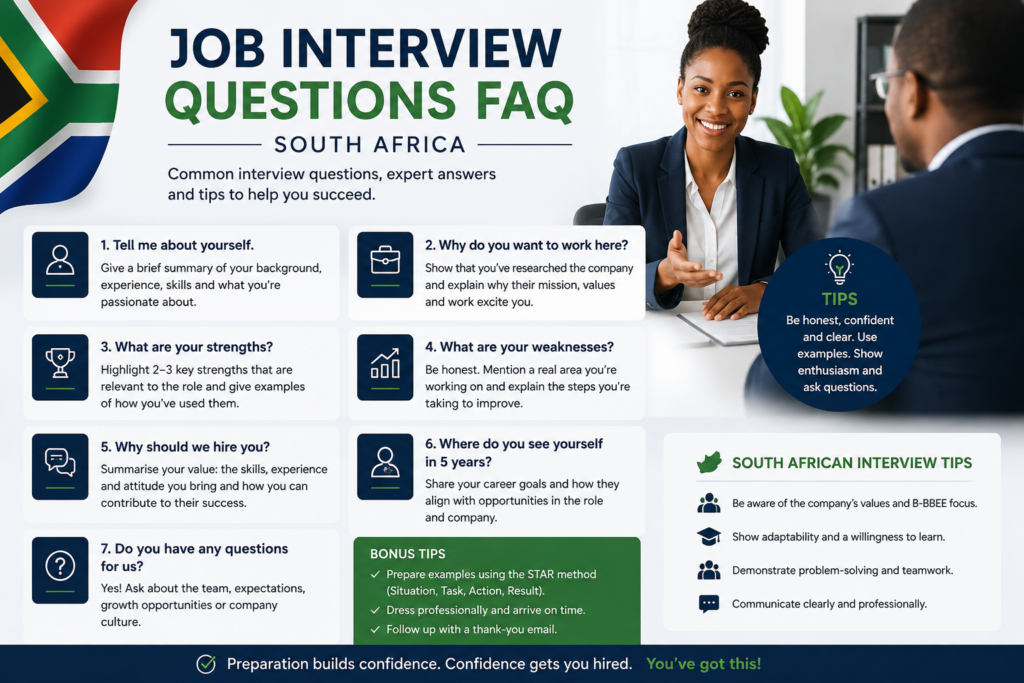
The final stage of many interviews focuses on your future plans, salary expectations, motivation, and overall suitability for the role.
These questions help employers understand whether your expectations align with the position and whether you’re likely to stay and grow within the organization.
Question 36: What Are Your Salary Expectations?
Sample Answer
“I’m open to discussing a salary that is fair and aligned with the responsibilities of the role, my qualifications, and industry standards. I’m more focused on finding the right opportunity where I can contribute and grow professionally.”
Pro Tip
Research salary ranges before the interview and avoid giving unrealistic figures.
Question 37: Are You Willing to Relocate?
Sample Answer
“Yes, I am willing to relocate if the opportunity supports my career growth and the relocation arrangements are practical.”
If you’re not willing to relocate, answer honestly and professionally.
Question 38: Why Are You Looking for a New Opportunity?
Sample Answer
“I’m looking for an opportunity that offers greater professional development, new challenges, and the ability to further develop my skills while contributing to a successful organization.”
Question 39: What Are Your Long-Term Career Goals?
Sample Answer
“My long-term goal is to continue developing professionally, gain deeper industry expertise, and eventually take on greater responsibilities where I can contribute to strategic objectives and mentor others.”
Question 40: What Does Success Mean to You?
Sample Answer
“Success means continuously improving, achieving meaningful goals, contributing positively to my team, and creating opportunities for personal and professional growth.”
Graduate and First-Time Job Seeker Questions
These questions are common for:
- Learnerships
- Internships
- Graduate programmes
- Entry-level positions
Don’t worry if you have limited work experience. Employers often focus on potential, attitude, and willingness to learn.
Question 41: Why Should We Hire You if You Have No Experience?
Sample Answer
“Although I may not have extensive professional experience, I bring enthusiasm, a strong willingness to learn, and skills developed through my education, projects, volunteering, and personal development. I’m eager to contribute and grow within the organization.”
Question 42: What Did You Learn From Your Studies?
Sample Answer
“My studies helped me develop analytical thinking, problem-solving skills, teamwork, communication, and the ability to manage deadlines effectively.”
Question 43: Describe a Time You Worked on a Project
Sample Answer
“During a group project, I helped organize tasks, coordinated communication among team members, and ensured deadlines were met. The project was completed successfully and received positive feedback.”
Question 44: How Do You Manage Your Time?
Sample Answer
“I use planning tools, prioritize important tasks, and create schedules to ensure deadlines are met efficiently without compromising quality.”
Question 45: What Have You Done to Improve Yourself Recently?
Sample Answer
“Recently, I completed online courses and focused on developing professional skills such as communication, problem-solving, and digital literacy to improve my employability.”
Final Interview Questions
These questions often appear near the end of an interview.
Question 46: Are You Comfortable Working Under Supervision?
Sample Answer
“Yes. I appreciate guidance from experienced supervisors and value feedback that helps me improve my performance.”
Question 47: Are You Comfortable Working Independently?
Sample Answer
“Yes. I’m capable of managing my responsibilities independently while ensuring I communicate effectively and seek assistance when necessary.”
Question 48: What Would Your Colleagues Say About You?
Sample Answer
“I believe my colleagues would describe me as reliable, professional, cooperative, and willing to assist others when needed.”
Question 49: Do You Have Any Questions for Us?
Sample Answer
“Yes, thank you.
I’d like to know:
- What does success look like in this role?
- What training opportunities are available?
- What are the next steps in the recruitment process?”
Important
Always ask at least one question.
It shows interest and professionalism.
Question 50: Is There Anything Else You Would Like Us to Know?
Sample Answer
“I’d like to emphasize my enthusiasm for this opportunity. I believe my skills, work ethic, and willingness to learn would allow me to make a positive contribution to your organization.”
Expert Interview Tips
The difference between average candidates and successful candidates often comes down to preparation.
Here are proven interview tips used by career coaches and recruitment professionals.
Arrive Early
Aim to arrive at least 15–20 minutes before the interview.
Practice Out Loud
Reading answers silently is not enough.
Practice speaking your answers confidently.
Maintain Positive Body Language
- Make eye contact
- Sit upright
- Smile naturally
- Avoid crossing your arms
Listen Carefully
Don’t rush to answer.
Take a moment to understand the question before responding.
Be Honest
If you don’t know something, admit it and explain your willingness to learn.
Employers value honesty.
Use Real Examples
Whenever possible, support your answers with practical examples.
Real examples make your responses stronger and more credible.
Common Interview Mistakes to Avoid
Even qualified candidates lose opportunities because of avoidable mistakes.
1. Arriving Late
Punctuality creates a strong first impression.
2. Not Researching the Company
Employers expect candidates to know basic information about the organization.
3. Speaking Negatively About Previous Employers
Maintain professionalism at all times.
4. Giving One-Word Answers
Expand on your answers and provide examples.
5. Not Asking Questions
Questions demonstrate interest and engagement.
6. Poor Grooming and Presentation
Professional appearance still matters.
7. Lack of Confidence
Preparation is the best way to improve confidence.
8. Providing False Information
Honesty builds trust.
Employers often verify qualifications and references.
Frequently Asked Questions
1. What is the most common interview question?
The most common question is:
“Tell me about yourself.”
Prepare a concise professional summary focusing on education, experience, skills, and career goals.
2. How long should interview answers be?
Most answers should be between 30 seconds and 2 minutes, depending on the complexity of the question.
3. What should I wear to a job interview?
Choose clean, professional clothing appropriate for the position and company culture.
4. How early should I arrive for an interview?
Arriving 15 to 20 minutes early is generally recommended.
5. What if I don’t know the answer to a question?
Stay calm, be honest, and explain how you would approach finding the solution.
6. Can I take notes into an interview?
Yes, especially if they contain questions for the interviewer or key points about the company.
7. How do I answer questions about weaknesses?
Choose a genuine weakness and explain how you’re actively improving it.
8. Should I discuss salary in the first interview?
If asked, answer professionally and remain flexible. Avoid bringing it up too early unless necessary.
9. What questions should I ask the interviewer?
Ask about:
- Success expectations
- Team structure
- Training opportunities
- Company culture
- Next steps
10. How can I reduce interview anxiety?
Preparation is the best solution. Practice common questions, research the company, and rehearse your answers beforehand.
Conclusion
Job interviews don’t have to be intimidating.
Most interviewers are not trying to trick you. They simply want to understand whether you have the skills, attitude, and potential to succeed in the role.
By preparing for common interview questions, researching the company, and practicing your answers, you’ll significantly improve your confidence and performance.
Remember that every interview is also a learning experience. Even if you don’t get the first opportunity, each interview helps you become more comfortable and better prepared for the next one.
The more you practice, the more natural your answers will become.
Final Takeaway
If you want to improve your chances of getting hired in South Africa:
Prepare for common interview questions
Research the company beforehand
Practice using real examples
Use the STAR method for behavioural questions
Dress professionally
Arrive early
Ask thoughtful questions
Remain confident and positive
Interview success is rarely about having perfect answers.
It’s about showing employers that you are prepared, professional, capable, and ready to contribute.
Master these 50 common job interview questions and answers, and you’ll walk into your next interview with far greater confidence.
Also read: How to Choose the Right Career Path in South Africa (For Students and Adults)