
Best Careers That Don’t Require a University Degree in South Africa. Choosing a successful career doesn’t always mean spending three or four years at university. In South Africa, many well-paying and rewarding careers are available to people who have a Matric certificate, vocational training, learnerships, apprenticeships, or industry certifications instead of a traditional university degree.
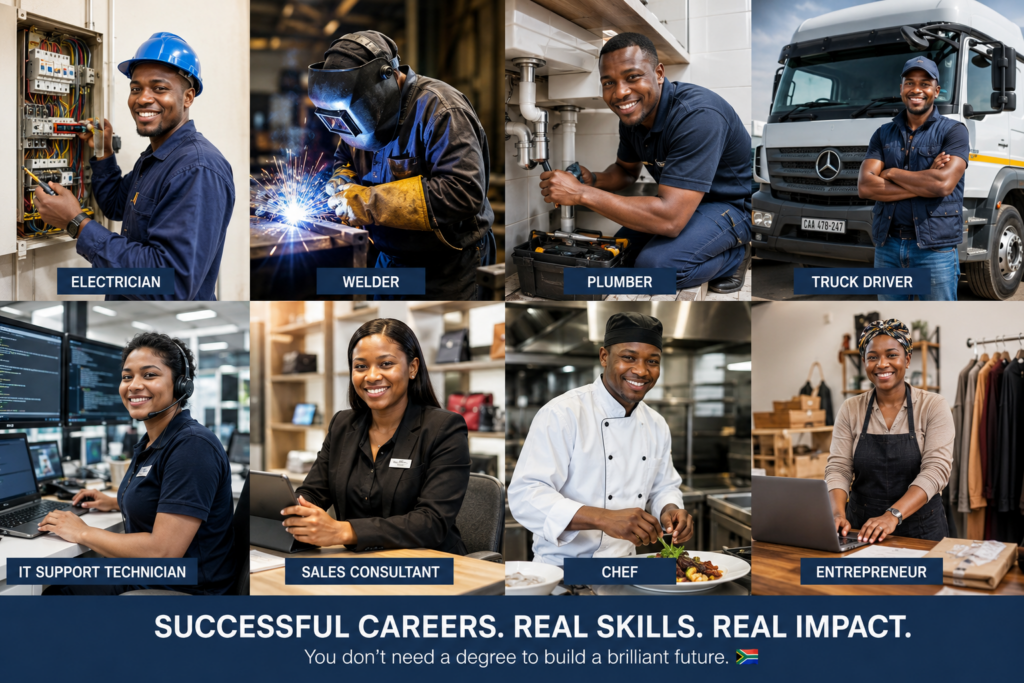
With the country’s growing demand for skilled workers, artisans, technicians, drivers, healthcare support staff, sales professionals, and digital specialists are becoming increasingly valuable. Many of these careers also offer opportunities to earn competitive salaries, gain practical experience, and even start your own business.
Whether you’re a recent Matric graduate, someone looking for a career change, or simply want to avoid university costs, there are plenty of career paths that can lead to long-term success.
In this guide, you’ll discover some of the best careers in South Africa that don’t require a university degree, the qualifications you may need, expected salary ranges, and how to get started.
What You Will Learn
In this guide, we’ll cover:
- Whether you need a university degree to build a successful career.
- The highest-paying careers that don’t require a degree.
- Skilled trade careers in South Africa.
- Technical and vocational careers.
- Careers in IT without a university qualification.
- Sales and customer service careers.
- Transport and logistics careers.
- Healthcare support careers.
- Creative and digital careers.
- How to choose the right career path based on your interests and strengths.
You’ll also learn which industries continue to experience strong demand for skilled workers and how you can begin building a rewarding career through practical training, certifications, and work experience.
Do You Need a University Degree to Build a Successful Career?
A university degree can open doors to certain professions, but it is not the only path to a successful career.
In South Africa, many employers are more interested in practical skills, workplace experience, reliability, technical ability, and recognised industry qualifications than in whether someone attended university.
Some careers legally require a university degree, such as becoming a doctor, attorney, pharmacist, or professional engineer. However, many other careers can be entered through:
- TVET college qualifications
- Learnerships
- Apprenticeships
- Trade tests
- Short courses
- Industry certificates
- Workplace training
- Entry-level employment
- Self-employment
The most important thing is choosing a career path that matches your abilities, interests, and long-term goals.
Skills Can Be More Valuable Than Qualifications Alone
Employers need workers who can solve problems and perform their duties competently.
For example, a qualified electrician who can install, maintain, and repair electrical systems may have stronger employment prospects than someone with a general qualification but no practical skills.
The same applies to:
- Welders
- Plumbers
- Fitters and turners
- Diesel mechanics
- Software developers
- Sales representatives
- Graphic designers
- Chefs
- Truck drivers
These careers depend heavily on practical ability, training, experience, and professional discipline.
Vocational Training Offers a Practical Alternative
Technical and Vocational Education and Training colleges provide career-focused programmes designed to prepare students for the workplace.
Depending on the programme, students can study areas such as:
- Engineering studies
- Electrical infrastructure
- Information technology
- Office administration
- Hospitality
- Tourism
- Finance
- Construction
- Safety management
Vocational training can be a suitable option for people who prefer learning through practical activities instead of mainly studying academic theory.
Learnerships Can Help You Gain Experience
Learnerships combine classroom learning with practical workplace experience.
They can help young South Africans:
- Gain an accredited qualification.
- Build work experience.
- Develop job-ready skills.
- Receive a monthly allowance in some programmes.
- Improve their chances of permanent employment.
Learnerships are offered by government departments, SETAs, municipalities, state-owned entities, and private companies.
They are especially useful for people who have completed Matric but do not have enough money to attend university.
Apprenticeships Lead to Skilled Trades
An apprenticeship is one of the most common routes into an artisan career.
Apprentices receive supervised practical training while learning a trade such as:
- Electrical work
- Welding
- Plumbing
- Boilermaking
- Fitting and turning
- Motor mechanics
- Millwright work
After completing the required training and workplace experience, candidates may qualify to complete a trade test.
Passing the trade test can lead to formal artisan recognition and better career opportunities.
Short Courses and Certifications Can Open Doors
Some careers require specialised certifications rather than a degree.
Examples include:
- IT support certificates
- Cybersecurity certificates
- Digital marketing training
- Occupational health and safety certificates
- Security officer training
- Forklift operator certification
- Welding qualifications
- Driver training
- Bookkeeping certificates
These programmes are often shorter and more affordable than university studies.
However, job seekers should always check whether the training provider is legitimate and whether employers recognise the qualification.
Work Experience Remains Important
Qualifications may help you enter a career, but experience often determines how quickly you progress.
You can build experience through:
- Internships
- Learnerships
- Apprenticeships
- Volunteer work
- Temporary jobs
- Freelance projects
- Part-time work
- Personal projects
- Small business activities
For example, someone interested in graphic design can create sample logos and social media posts to build a portfolio. A person interested in welding can begin by helping with small fabrication projects while improving their skills.
You Can Also Become Self-Employed
Many careers that do not require a degree offer strong opportunities for self-employment.
A skilled person may eventually start a business offering services such as:
- Plumbing repairs
- Electrical maintenance
- Welding and fabrication
- Appliance repair
- Cleaning services
- Landscaping
- Catering
- Photography
- Web design
- Mobile phone repair
Self-employment requires discipline, customer service, marketing, and financial management, but it can provide greater control over your income and working hours.
A university degree can be valuable, but it is not the only measure of intelligence, ambition, or career potential.
Practical skills, recognised training, experience, and consistency can also lead to a secure and rewarding future.
1. Skilled Trade Careers (Artisans)
Skilled trades remain among the most reliable career paths in South Africa. As infrastructure projects, housing developments, manufacturing, mining, and renewable energy continue to grow, qualified artisans remain in high demand.
Most artisan careers require vocational training, apprenticeships, and a trade test rather than a university degree.
Many experienced artisans also earn additional income through overtime, contract work, or running their own businesses.
Electrician
Electricians install, repair, and maintain electrical systems in homes, businesses, factories, and industrial plants.
Typical duties include:
- Installing wiring systems
- Repairing electrical faults
- Reading electrical diagrams
- Installing lighting and distribution boards
- Conducting maintenance inspections
Typical Requirements:
- Matric (recommended)
- TVET Electrical qualification
- Apprenticeship
- Trade Test
Estimated Salary:
- Entry Level: R12,000–R20,000 per month
- Experienced: R25,000–R45,000+ per month
Electricians who specialise in industrial maintenance or renewable energy often earn even higher salaries.
Plumber
Plumbers install and repair water supply, drainage, and sanitation systems.
They work on:
- Residential homes
- Commercial buildings
- Factories
- Municipal infrastructure
- Construction projects
Demand for qualified plumbers remains consistently strong across South Africa.
Typical Requirements:
- Apprenticeship
- TVET qualification
- Trade Test
Estimated Salary:
- R12,000–R35,000+ per month
Many plumbers eventually establish successful private plumbing businesses.
Welder
Welding is one of the most respected artisan careers in South Africa.
Qualified welders work in:
- Construction
- Manufacturing
- Mining
- Shipbuilding
- Engineering
- Oil and gas
- Steel fabrication
Common welding processes include:
- ARC (Stick)
- MIG (CO₂)
- TIG (Argon)
- Flux-core welding
Experienced coded welders often earn significantly more than entry-level welders.
Typical Requirements:
- Welding training course
- Practical experience
- Trade qualification (optional but beneficial)
Estimated Salary:
- Entry Level: R10,000–R18,000 per month
- Experienced: R20,000–R45,000+ per month
Many welders also operate their own fabrication businesses, manufacturing gates, burglar bars, trailers, and steel structures.
Diesel Mechanic
Diesel mechanics repair heavy vehicles and machinery.
Typical employers include:
- Truck companies
- Mining operations
- Agriculture
- Municipal fleets
- Bus companies
- Construction firms
Typical Requirements:
- Apprenticeship
- Technical qualification
- Trade Test
Estimated Salary:
- R18,000–R45,000+ per month
Specialists working on mining or heavy industrial equipment often earn higher salaries.
Boilermaker
Boilermakers manufacture and repair large steel structures, tanks, pressure vessels, and industrial equipment.
They commonly work in:
- Mining
- Petrochemical plants
- Power stations
- Manufacturing
- Heavy engineering
Estimated Salary:
- R18,000–R50,000+ per month
Due to the technical nature of the work, experienced boilermakers are highly valued.
Fitter and Turner
Fitters and turners manufacture, assemble, repair, and maintain precision mechanical equipment.
They work with:
- Industrial machines
- Manufacturing equipment
- Pumps
- Compressors
- Production plants
Estimated Salary:
- R18,000–R45,000+ per month
Precision engineering skills remain highly sought after throughout South Africa.
Why Skilled Trades Are Excellent Career Choices
Artisan careers offer several long-term advantages:
- Strong employment demand
- Practical hands-on work
- Opportunities to work locally or internationally
- Good salary growth with experience
- Possibility of overtime income
- Excellent opportunities for self-employment
Many artisans eventually become contractors, business owners, or supervisors after gaining several years of experience.
For people who enjoy solving practical problems and working with their hands, skilled trades remain among the best careers available without a university degree.
2. Information Technology (IT) Careers Without a Degree
The technology industry is one of the fastest-growing sectors in South Africa, and many employers now hire people based on their skills, certifications, and portfolios rather than a university qualification.
If you enjoy working with computers, solving technical problems, or learning new technology, IT can provide excellent career opportunities with strong salary growth.
Many successful IT professionals began their careers through online certifications, bootcamps, self-study, or entry-level support roles.
IT Support Technician
IT Support Technicians help businesses keep their computers, networks, and software running smoothly.
Typical responsibilities include:
- Installing computers and laptops
- Troubleshooting hardware problems
- Fixing software issues
- Assisting employees with technical problems
- Configuring printers and networks
- Installing operating systems
This is one of the easiest IT careers to enter without a university degree.
Typical Requirements:
- Matric
- IT Support Certificate
- CompTIA A+ (advantage)
- Basic networking knowledge
Estimated Salary:
- Entry Level: R10,000–R18,000 per month
- Experienced: R20,000–R35,000+ per month
Help Desk Technician
Help Desk Technicians provide technical support remotely or in person.
They often work for:
- Banks
- Internet providers
- Government departments
- Corporate companies
- IT service providers
Daily tasks include:
- Answering technical queries
- Resetting passwords
- Solving computer issues
- Logging support tickets
- Assisting remote users
Estimated Salary:
- R10,000–R25,000 per month
Many Help Desk Technicians later become Network Administrators or Systems Engineers.
Junior Software Developer
Although many software developers have degrees, thousands of successful programmers are self-taught or learned through coding bootcamps and online certifications.
Popular programming languages include:
- Python
- JavaScript
- PHP
- Java
- C#
- SQL
Employers usually care more about your coding ability and portfolio than your academic qualifications.
Typical Requirements:
- Coding skills
- Portfolio of projects
- GitHub profile
- Practical experience
Estimated Salary:
- Junior Developer: R18,000–R35,000 per month
- Experienced Developer: R45,000–R80,000+ per month
Web Designer
Web Designers create attractive and user-friendly websites for businesses.
Skills commonly required include:
- HTML
- CSS
- WordPress
- Elementor
- UI/UX design
- Basic graphic design
Many web designers work as freelancers or operate their own agencies.
Estimated Salary:
- Freelance income varies greatly.
- Full-time salaries typically range between R15,000 and R40,000+ per month.
Cybersecurity Technician
Cybersecurity professionals help protect businesses from hackers, viruses, and cybercrime.
Responsibilities include:
- Monitoring security systems
- Identifying vulnerabilities
- Responding to cyber incidents
- Performing security assessments
- Protecting company networks
Industry certifications are often more important than a university qualification.
Popular certifications include:
- CompTIA Security+
- Google Cybersecurity Certificate
- Cisco CyberOps
- Microsoft Security certifications
Estimated Salary:
- Entry Level: R20,000–R35,000 per month
- Experienced: R45,000–R90,000+ per month
Digital Marketing Specialist
Businesses increasingly rely on digital marketing to attract customers.
Digital marketers may specialise in:
- Social media marketing
- Search Engine Optimisation (SEO)
- Google Ads
- Facebook Ads
- Email marketing
- Content creation
Many professionals enter this field through online courses and practical experience.
Estimated Salary:
- Entry Level: R12,000–R22,000 per month
- Experienced: R30,000–R60,000+ per month
Freelancers can often earn additional income by managing multiple clients.
Why IT Is an Excellent Career Without a Degree
Technology continues to create new job opportunities every year.
Advantages of working in IT include:
- High earning potential
- Opportunities to work remotely
- Continuous career growth
- International employment opportunities
- Freelancing and consulting options
- Ability to build a career through certifications instead of a degree
The key to success is continuous learning. Technology changes rapidly, so professionals who regularly update their skills remain highly competitive in the job market.
3. Transport and Logistics Careers
South Africa’s economy depends heavily on the transport and logistics industry. Goods need to be moved between ports, factories, warehouses, retail stores, and customers every day.
This creates thousands of employment opportunities for people who do not have university degrees.
Many transport careers require specialised licences, practical training, and experience rather than academic qualifications.
Truck Driver
Truck drivers transport goods across cities, provinces, and even neighbouring countries.
They may work in industries such as:
- Retail
- Mining
- Agriculture
- Construction
- Manufacturing
- Freight and logistics
Depending on the employer, drivers may operate:
- Heavy-duty trucks
- Tankers
- Refrigerated vehicles
- Flatbed trailers
- Long-distance haulage trucks
Typical Requirements:
- Valid Code 10 or Code 14 driver’s licence
- Professional Driving Permit (PrDP)
- Safe driving record
- Driving experience
Estimated Salary:
- Entry Level: R10,000–R18,000 per month
- Experienced: R20,000–R40,000+ per month
International and cross-border drivers often earn additional allowances.
Forklift Operator
Forklift operators move heavy goods inside:
- Warehouses
- Distribution centres
- Manufacturing plants
- Ports
- Logistics companies
The job requires precision, concentration, and strict adherence to safety procedures.
Typical Requirements:
- Forklift operator certificate
- Medical fitness
- Workplace safety training
Estimated Salary:
- R8,000–R18,000 per month
Experienced operators can move into warehouse supervision or logistics management roles.
Warehouse Supervisor
Warehouse supervisors oversee the movement of stock and ensure warehouse operations run efficiently.
Responsibilities include:
- Managing staff
- Monitoring stock levels
- Scheduling deliveries
- Quality control
- Health and safety compliance
Many supervisors begin as warehouse assistants before being promoted.
Estimated Salary:
- R15,000–R35,000+ per month
Delivery Driver
The growth of online shopping has increased demand for delivery drivers.
Common employers include:
- Courier companies
- Supermarkets
- Restaurants
- E-commerce businesses
- Pharmaceutical companies
Some delivery drivers also operate independently using their own vehicles.
Typical Requirements:
- Valid driver’s licence
- Good customer service skills
- Smartphone navigation skills
Estimated Salary:
- R8,000–R20,000+ per month
Income may increase through overtime, tips, or incentive programmes.
Logistics Coordinator
Logistics coordinators help organise the movement of goods between suppliers, warehouses, and customers.
Typical duties include:
- Scheduling deliveries
- Monitoring shipments
- Coordinating drivers
- Managing inventory
- Communicating with suppliers
Although some employers prefer diplomas, many candidates enter the field through practical experience in warehousing or administration.
Estimated Salary:
- R15,000–R35,000+ per month
Why Transport and Logistics Are Good Career Choices
Transport and logistics remain essential to South Africa’s economy.
Benefits include:
- Stable employment opportunities
- Career progression into supervisory roles
- Opportunities for overtime
- Growing demand due to e-commerce
- Possibility of starting your own transport business
For people who enjoy driving, planning, organisation, or working in fast-paced environments, transport and logistics offer rewarding career opportunities without requiring a university degree.
4. Sales and Customer Service Careers
Sales and customer service careers are among the easiest professions to enter without a university degree. Companies across South Africa are constantly looking for people with excellent communication skills, confidence, and the ability to build relationships with customers.
Many of these positions offer a basic salary plus commission, allowing high-performing employees to earn significantly more than their starting salary.
Sales Consultant
Sales consultants help customers choose products or services while achieving company sales targets.
They work in industries such as:
- Telecommunications
- Motor dealerships
- Furniture stores
- Electronics retailers
- Insurance companies
- Real estate
- Banking
Successful sales consultants are confident, friendly, and motivated by achieving targets.
Typical Requirements:
- Matric
- Good communication skills
- Customer service experience (advantage)
- Sales experience (helpful but not always required)
Estimated Salary:
- Basic Salary: R8,000–R18,000 per month
- With commission: R20,000–R50,000+ per month
Top-performing sales professionals often earn far above their basic salary.
Call Centre Agent
Call centre agents assist customers over the phone, email, or online chat.
Responsibilities may include:
- Answering customer enquiries
- Solving complaints
- Processing orders
- Technical support
- Sales calls
- Appointment bookings
Many companies provide full training to new employees.
Typical Requirements:
- Matric
- Good English communication
- Computer literacy
- Customer service skills
Estimated Salary:
- Entry Level: R7,500–R15,000 per month
- Experienced: R18,000–R30,000+ per month
Some sales-based call centres also offer attractive commission structures.
Customer Service Representative
Customer service representatives help customers before, during, and after a purchase.
They may work in:
- Retail stores
- Banks
- Airlines
- Hotels
- Government service centres
- Online businesses
Key responsibilities include:
- Handling customer enquiries
- Resolving complaints
- Processing returns
- Explaining products and services
- Maintaining customer satisfaction
Estimated Salary:
- R9,000–R22,000 per month
Excellent customer service skills can lead to supervisory or management positions.
Retail Store Manager
Many retail managers begin their careers as cashiers or sales assistants before working their way up.
Responsibilities include:
- Managing staff
- Controlling stock
- Meeting sales targets
- Scheduling employees
- Customer service
- Financial reporting
Large retailers often provide management training programmes for high-performing employees.
Estimated Salary:
- R18,000–R45,000+ per month
Store managers at national retail chains may receive performance bonuses in addition to their salary.
Real Estate Agent
Real estate agents help clients buy, sell, and rent residential or commercial property.
This career rewards people who enjoy networking, negotiation, and sales.
Income is usually commission-based, meaning earnings depend on successful property transactions.
Typical Requirements:
- Real estate training
- Registration with the relevant professional authority
- Sales ability
- Driver’s licence (often preferred)
Estimated Earnings:
- Beginners: Income may vary significantly.
- Experienced agents can earn R30,000–R100,000+ per month depending on sales performance.
Insurance Sales Advisor
Insurance companies regularly recruit advisors to sell:
- Life insurance
- Vehicle insurance
- Home insurance
- Medical cover
- Funeral policies
- Business insurance
Many employers provide product training and assistance with industry accreditation.
Estimated Salary:
- Basic Salary: R10,000–R20,000 per month
- With commission: R25,000–R60,000+ per month
Why Sales and Customer Service Are Great Career Choices
Sales careers reward effort, confidence, and strong people skills rather than academic qualifications.
Some of the biggest advantages include:
- Low barriers to entry
- Performance-based income
- Career advancement opportunities
- Valuable communication skills
- Opportunities to move into management
- Excellent experience for future entrepreneurs
People who enjoy working with others, solving problems, and achieving goals often thrive in sales and customer service careers.
5. Healthcare Support Careers
You don’t need to become a doctor or nurse to build a rewarding career in the healthcare industry. South Africa’s growing healthcare sector offers many opportunities for people who have vocational training, short courses, or specialised certifications instead of a university degree.
These careers allow you to make a real difference in people’s lives while enjoying stable employment and opportunities for career growth.
Caregiver
Caregivers provide daily assistance to elderly people, people living with disabilities, and patients recovering from illness.
Typical responsibilities include:
- Assisting with personal hygiene
- Preparing meals
- Helping patients move safely
- Monitoring basic health conditions
- Providing companionship
- Administering medication under supervision (where permitted)
Caregivers work in:
- Private homes
- Retirement villages
- Hospitals
- Rehabilitation centres
- Hospice facilities
Typical Requirements:
- Caregiver certificate
- Basic First Aid training (advantage)
- Compassion and patience
Estimated Salary:
- Entry Level: R6,500–R10,000 per month
- Experienced: R12,000–R20,000+ per month
Private caregivers may earn more depending on experience and working hours.
Ambulance Emergency Assistant (Basic Life Support)
Emergency medical personnel respond to accidents, medical emergencies, and patient transport.
They help:
- Stabilise injured patients
- Provide emergency first aid
- Assist paramedics
- Transport patients safely
- Monitor patient conditions
Although advanced paramedic careers require more extensive qualifications, entry-level emergency care roles can begin through accredited emergency medical training.
Estimated Salary:
- R15,000–R35,000+ per month
Shift allowances and overtime can increase overall earnings.
Pharmacy Assistant
Pharmacy assistants support pharmacists by helping prepare and dispense medication while serving customers.
Typical duties include:
- Assisting customers
- Stock control
- Processing prescriptions
- Organising medication
- Administrative work
They may work in:
- Community pharmacies
- Hospitals
- Private clinics
- Pharmaceutical companies
Typical Requirements:
- Accredited Pharmacy Assistant training
- Registration where required
Estimated Salary:
- R10,000–R22,000 per month
Dental Assistant
Dental assistants work alongside dentists during patient treatment.
Responsibilities include:
- Preparing treatment rooms
- Sterilising equipment
- Assisting during procedures
- Scheduling appointments
- Maintaining patient records
The role suits people who enjoy healthcare and working directly with patients.
Estimated Salary:
- R10,000–R25,000 per month
Experienced dental assistants working in specialist practices often earn higher salaries.
Medical Receptionist
Medical receptionists manage the front office of healthcare facilities.
Daily tasks include:
- Booking appointments
- Welcoming patients
- Handling telephone enquiries
- Managing patient records
- Processing payments
- Communicating with medical aid providers
Employers include:
- Private doctors
- Specialists
- Dentists
- Hospitals
- Medical centres
Typical Requirements:
- Matric
- Computer literacy
- Good communication skills
- Administrative experience (advantage)
Estimated Salary:
- R9,000–R18,000 per month
Why Healthcare Support Careers Are Worth Considering
Healthcare support professionals are essential to keeping South Africa’s healthcare system running efficiently.
Benefits include:
- Stable employment opportunities
- Meaningful work helping others
- Opportunities for career advancement
- Growing demand due to an ageing population
- Work available in both public and private healthcare
If you enjoy caring for people, communicating with patients, and working in a professional environment, healthcare support can provide a fulfilling career without requiring a university degree.
6. Hospitality and Tourism Careers
South Africa’s hospitality and tourism industry employs thousands of people every year. Hotels, restaurants, lodges, resorts, airlines, cruise companies, and tourism businesses regularly recruit people who have practical skills and excellent customer service rather than university degrees.
These careers are ideal for people who enjoy working with others, solving problems, and creating memorable experiences for guests.
Chef
Professional chefs prepare meals in restaurants, hotels, resorts, hospitals, schools, and catering companies.
Responsibilities include:
- Preparing food
- Planning menus
- Managing kitchen hygiene
- Supervising kitchen staff
- Controlling food quality
- Managing stock
Many successful chefs start as kitchen assistants before completing culinary training and gaining experience.
Typical Requirements:
- Culinary certificate (recommended)
- Practical kitchen experience
- Food safety knowledge
Estimated Salary:
- Entry Level: R8,000–R15,000 per month
- Experienced: R20,000–R45,000+ per month
Executive chefs at luxury hotels can earn considerably more.
Hotel Receptionist
Hotel receptionists are responsible for creating a positive first impression for guests.
Daily duties include:
- Checking guests in and out
- Answering telephone calls
- Managing reservations
- Handling guest enquiries
- Processing payments
- Providing local travel information
Typical Requirements:
- Matric
- Computer literacy
- Customer service skills
- Good communication
Estimated Salary:
- R8,000–R18,000 per month
Receptionists often progress into hotel administration or management roles.
Tour Guide
Tour guides introduce visitors to South Africa’s history, culture, wildlife, and attractions.
They may specialise in:
- Safari tours
- Historical sites
- Adventure tourism
- Cultural experiences
- City tours
- Nature reserves
Good communication skills and local knowledge are essential.
Typical Requirements:
- Accredited tour guide training
- Registration where required
- Knowledge of local attractions
Estimated Salary:
- R10,000–R30,000+ per month
Many guides also earn tips from satisfied tourists.
Event Coordinator
Event coordinators organise:
- Weddings
- Conferences
- Corporate events
- Festivals
- Private functions
- Exhibitions
Responsibilities include:
- Booking venues
- Coordinating suppliers
- Managing budgets
- Supervising event setup
- Ensuring events run smoothly
Many professionals build experience through practical work rather than formal degrees.
Estimated Salary:
- R15,000–R40,000+ per month
Experienced coordinators often establish their own event planning businesses.
Barista
Coffee culture continues to grow across South Africa, creating demand for skilled baristas.
Baristas prepare:
- Espresso
- Cappuccinos
- Lattes
- Specialty coffees
- Cold beverages
They also provide excellent customer service in cafés and restaurants.
Typical Requirements:
- Barista training (advantage)
- Customer service skills
- Food safety knowledge
Estimated Salary:
- R7,000–R15,000 per month
Tips can increase monthly earnings.
Why Hospitality Is a Great Career Choice
Hospitality offers many opportunities for career growth.
Benefits include:
- Practical training opportunities
- Promotion into management
- International employment opportunities
- Customer service experience
- Flexible working environments
- Possibility of starting your own hospitality business
For people who enjoy working with people and thrive in fast-paced environments, hospitality can be both enjoyable and financially rewarding.
Image Prompt:
A realistic South African luxury hotel and hospitality environment featuring a chef preparing gourmet meals, a hotel receptionist welcoming guests, a professional tour guide leading international tourists, an event coordinator overseeing a wedding venue, and a skilled barista serving coffee in a modern café, natural lighting, authentic South African hospitality industry, Google AdSense friendly, ultra-realistic photography style.
7. Entrepreneurship and Self-Employment
One of the biggest advantages of learning practical skills instead of pursuing a university degree is the opportunity to become your own boss.
Thousands of South Africans earn a good living by providing services directly to customers or running small businesses.
Many successful entrepreneurs started with very little capital but built profitable businesses through hard work, quality service, and strong customer relationships.
Popular businesses that don’t require a university degree include:
- Welding and steel fabrication
- Plumbing services
- Electrical contracting
- Mobile phone repairs
- Appliance repairs
- Landscaping and gardening
- Home cleaning services
- Car washing and detailing
- Photography
- Catering and baking
- Hairdressing and barbering
- Graphic design
- Web design
- Digital marketing
- Printing services
- Furniture manufacturing
Skills Every Entrepreneur Needs
Running a successful business requires more than technical ability.
Important skills include:
- Customer service
- Communication
- Marketing
- Financial management
- Time management
- Problem-solving
- Negotiation
- Planning
Fortunately, many of these skills can be learned through experience, online courses, and mentorship.
Benefits of Self-Employment
Starting your own business can provide:
- Unlimited earning potential
- Flexible working hours
- Independence
- Opportunities to employ others
- Personal satisfaction
- Long-term financial growth
Although entrepreneurship comes with challenges, it can be one of the most rewarding career paths for motivated individuals.
How to Choose the Right Career Without a University Degree
Not everyone enjoys the same type of work, and that’s perfectly normal. The best career is one that matches your interests, strengths, personality, and long-term goals—not simply the one with the highest salary.
Before choosing a career, take some time to think about what you enjoy doing and the kind of lifestyle you want in the future.
Ask Yourself These Questions
Choosing the right career starts with understanding yourself.
Consider the following questions:
- Do I enjoy working with my hands?
- Do I prefer working with people or machines?
- Am I comfortable working indoors or outdoors?
- Do I enjoy solving technical problems?
- Would I rather work independently or as part of a team?
- Am I interested in helping people?
- Do I enjoy driving or travelling?
- Am I creative?
- Do I enjoy working with computers?
Your answers can help narrow down careers that suit your personality.
Match Your Interests to Careers
Here are a few examples:
If You Enjoy Working With Your Hands
Consider careers such as:
- Electrician
- Welder
- Plumber
- Boilermaker
- Carpenter
- Diesel Mechanic
These careers involve practical work and often offer strong earning potential.
If You Enjoy Technology
You might enjoy:
- IT Support
- Software Development
- Web Design
- Cybersecurity
- Digital Marketing
Technology careers continue to grow rapidly and often offer remote work opportunities.
If You Enjoy Helping People
Suitable careers include:
- Caregiver
- Medical Receptionist
- Pharmacy Assistant
- Customer Service Representative
- Hospitality
These careers require patience, communication, and empathy.
If You Enjoy Driving
You could consider becoming:
- Truck Driver
- Delivery Driver
- Logistics Coordinator
- Courier Driver
Transport careers often offer steady employment and opportunities for overtime.
If You Enjoy Sales
You may enjoy working as:
- Sales Consultant
- Real Estate Agent
- Insurance Advisor
- Retail Manager
These careers reward confidence, communication skills, and motivation.
If You Want to Own a Business
Entrepreneurship may be the right path.
Examples include:
- Welding business
- Plumbing company
- Electrical contracting
- Catering business
- Hair salon
- Mobile phone repair shop
- Web design agency
- Cleaning company
Owning a business requires commitment, but it also provides the opportunity to build long-term financial independence.
Continue Learning Throughout Your Career
One of the biggest advantages of today’s job market is that learning never has to stop.
As your career grows, you can improve your qualifications through:
- Online courses
- Industry certifications
- Learnerships
- Apprenticeships
- Short courses
- Workplace training
- Professional workshops
Continuous learning helps you stay competitive and opens the door to promotions and higher-paying opportunities.
Don’t Be Afraid to Start Small
Many successful professionals began in entry-level positions.
For example:
- A general worker becomes a supervisor.
- A welding assistant becomes a coded welder.
- A warehouse assistant becomes a logistics manager.
- A sales consultant becomes a regional manager.
- An IT support technician becomes a systems administrator.
Every career starts with a first opportunity.
The most important step is to gain experience, build your reputation, and continue developing your skills.
Image Prompt:
A realistic South African career advisor helping a young adult choose between different career paths, with posters showing skilled trades, IT, healthcare, transport, hospitality, and entrepreneurship, modern career guidance centre, diverse South African people, hopeful atmosphere, natural lighting, Google AdSense friendly, ultra-realistic photography style.
Final Thoughts
A university degree is only one pathway to success. Across South Africa, thousands of people build rewarding and financially stable careers through vocational training, apprenticeships, certifications, practical experience, and determination.
Whether you choose to become an artisan, IT professional, truck driver, chef, salesperson, healthcare worker, or entrepreneur, your success will depend on your willingness to learn, work hard, and continuously improve your skills.
Remember these key points:
- Choose a career that matches your interests and strengths.
- Invest in recognised training and certifications.
- Gain practical experience whenever possible.
- Build a professional CV and continue improving your skills.
- Stay open to new opportunities and career growth.
- Don’t let the lack of a university degree stop you from pursuing your goals.
Many of South Africa’s most successful professionals and business owners started with practical skills, a strong work ethic, and a commitment to lifelong learning.
Your career journey begins with the decision to take the first step.
Featured Image Prompt:
A realistic South African collage of successful professionals without university degrees, including a welder, electrician, IT technician, truck driver, chef, caregiver, sales consultant, entrepreneur, and plumber standing proudly in front of their workplaces, modern South African city skyline in the background, inspirational atmosphere, natural lighting, diverse workforce, Google AdSense friendly, ultra-realistic photography style.
Frequently Asked Questions (FAQs)
Can I get a good job without a university degree in South Africa?
Yes. Many careers, including skilled trades, IT support, sales, logistics, hospitality, and healthcare support, offer good salaries and career growth without requiring a university degree. Employers often value practical skills and experience just as much as formal education.
Which careers pay the most without a degree?
Some of the highest-paying careers without a university degree include:
- Electrician
- Boilermaker
- Diesel Mechanic
- Software Developer
- Cybersecurity Technician
- Real Estate Agent
- Entrepreneur
- Sales Consultant (with commission)
Income depends on your skills, experience, and the industry you work in.
Do I need Matric for these careers?
Many careers require a Grade 12 (Matric) certificate, but not all. Some apprenticeships, learnerships, and vocational programmes have different entry requirements. Always check the specific requirements before applying.
Can I study while working?
Yes. Many professionals improve their qualifications through part-time studies, online courses, and industry certifications while continuing to work full-time.
Are artisans in demand in South Africa?
Yes. Skilled artisans such as electricians, welders, plumbers, diesel mechanics, and boilermakers continue to be in high demand across construction, manufacturing, mining, and infrastructure sectors.
Also read: Best Careers for People Who Like Working With Their Hands
and also read: Best Free Online Courses for Job Seekers in South Africa
Thank you for reading this informative article. Take care.