
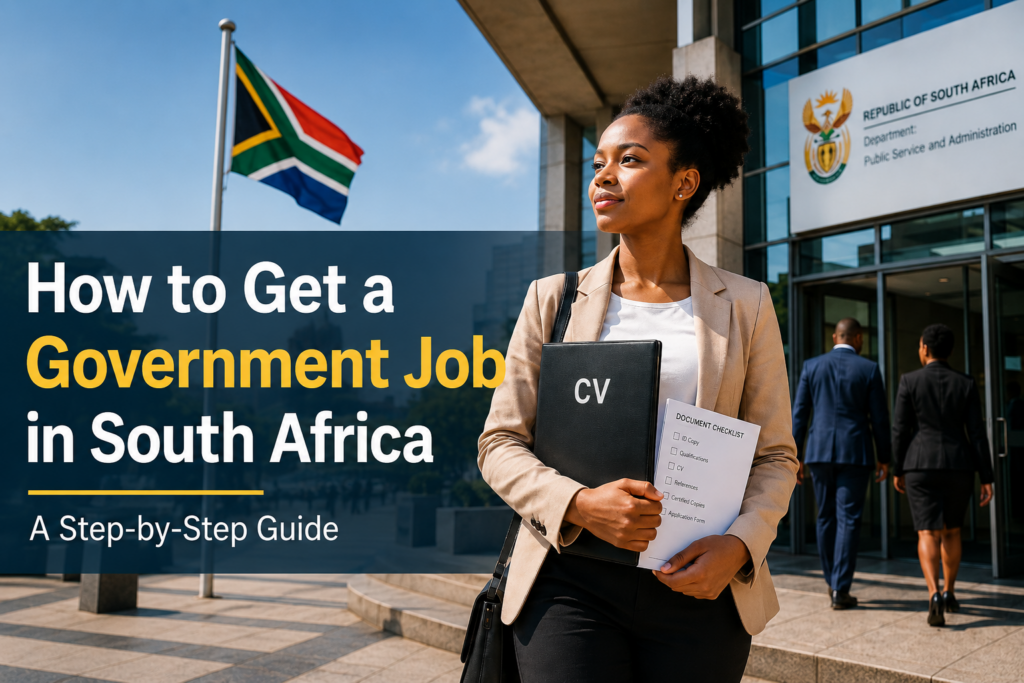
How to Get a Government Job in South Africa: A Step-by-Step Guide. Working for the South African government is a career goal for many people, and for good reason. Government jobs are known for offering competitive salaries, stable employment, comprehensive employee benefits, opportunities for career growth, and the chance to serve communities across the country.
Whether you dream of working for the Department of Health, the South African Police Service (SAPS), the Department of Home Affairs, SARS, Eskom, Transnet, or your local municipality, thousands of government vacancies are advertised every year. These positions range from entry-level administrative roles to highly skilled professional careers in healthcare, education, engineering, finance, information technology, law enforcement, and public administration.
However, many job seekers believe that getting a government job is difficult or requires knowing the “right people.” While government recruitment can be competitive, the reality is that most public sector vacancies follow formal recruitment procedures based on qualifications, experience, and merit. Understanding how the recruitment process works can significantly improve your chances of success.
In this comprehensive guide, you’ll learn exactly how to find legitimate government vacancies, understand the application process, prepare the required documents, complete your application correctly, and improve your chances of securing an interview. Whether you’re a recent matriculant, university graduate, artisan, or experienced professional looking for a stable career, this guide will help you navigate the South African government recruitment process with confidence.
By the end of this article, you’ll have a clear roadmap for applying to government jobs and avoiding the common mistakes that cause many applications to be rejected.
What You Will Learn in This Guide
Applying for a government job is different from applying to many private companies. Public service vacancies usually follow specific instructions, closing dates, reference numbers, and document requirements.
In this guide, you will learn:
- Where to find legitimate government vacancies
- How to understand a government job advertisement
- How to complete the Z83 application form
- How to prepare a suitable government-job CV
- Which supporting documents may be required
- How to submit your application correctly
- What happens after you apply
- How to prepare for a government job interview
- Which common mistakes can disqualify your application
- How to protect yourself from government job scams
Following every instruction carefully is essential. A candidate may have the right qualifications but still be excluded because the application was incomplete, submitted late, or sent to the wrong address.
The Department of Public Service and Administration publishes the Public Service Vacancy Circular, normally every week except during December. Applicants must send their applications directly to the department advertising the position and include the vacancy’s reference number.
Step 1: Decide What Type of Government Job You Want
Before submitting applications, identify the type of government work that matches your qualifications, experience, interests, and career goals.
Government is a large employer with opportunities across national departments, provincial administrations, public entities, municipalities, hospitals, schools, police services, and other institutions.
Applying for every vacancy you see is rarely effective. A focused job search allows you to prepare stronger applications for positions that genuinely match your background.
National Government Departments
National departments manage programmes and services that operate across South Africa.
Examples of career areas include:
- Public administration
- Finance and auditing
- Information technology
- Legal services
- Communications
- Human resources
- Policy development
- Monitoring and evaluation
- Supply chain management
- Project management
These positions may be based at head offices, regional offices, or service centres in different provinces.
Provincial Government Departments
The Provincial departments employ people in areas such as:
- Healthcare
- Education
- Social development
- Public works
- Agriculture
- Transport
- Community safety
- Economic development
Provincial vacancies may be suitable for candidates who want to work closer to their communities.
Municipal Jobs
Municipalities employ workers who help deliver services at local level.
These careers can include:
- Administration
- Traffic services
- Waste management
- Water and sanitation
- Electrical services
- Roads and infrastructure
- Town planning
- Fire and emergency services
- Customer service
- Finance
Municipal recruitment is often handled separately from the national Public Service Vacancy Circular, so applicants should also check official municipal websites.
Government Jobs for Different Qualification Levels
Not every government position requires a university degree.
Depending on the advertisement, opportunities may be available for people with:
- Grade 10
- Matric
- National certificates
- TVET qualifications
- Diplomas
- Degrees
- Trade qualifications
- Professional registrations
- Specialist experience
Entry-level positions may include clerical support, general work, driving, cleaning, security support, data capturing, registry work, administration, and customer service.
Professional posts may require qualifications and registration in fields such as nursing, teaching, engineering, law, finance, social work, or healthcare.
Match Yourself to the Position
Before applying, compare the advertisement with your profile.
Check whether you meet the stated:
- Educational requirements
- Experience requirements
- Skills and competencies
- Registration requirements
- Driver’s licence requirements
- Language requirements
- Location expectations
You do not need to match every minor preference, but you should normally meet the essential requirements.
Applying for positions for which you are clearly underqualified can waste time and reduce the quality of your overall job search.
Choose a Few Target Job Categories
Create a focused list of job titles you will search for regularly.
For example, someone with matric and office experience might target:
- Administrative Clerk
- Registry Clerk
- Data Capturer
- Receptionist
- Human Resource Clerk
- Finance Clerk
- Supply Chain Clerk
A qualified artisan might target:
- Maintenance Officer
- Welder
- Electrician
- Mechanical Artisan
- Works Inspector
- Technical Assistant
A graduate might target entry-level professional posts, internships, graduate programmes, assistant officer roles, or junior administrative positions.
A clear target makes it easier to find relevant vacancies and tailor your CV properly.
Step 2: Find Legitimate Government Job Vacancies
One of the biggest mistakes job seekers make is relying only on social media posts or WhatsApp groups for government vacancies. While these platforms may share genuine opportunities, they can also spread outdated adverts or even scams.
The safest approach is to use official government sources whenever possible.
Check the Public Service Vacancy Circular (PSVC)
The Public Service Vacancy Circular is the primary source of government vacancies in South Africa.
Every week, government departments advertise available positions through the Circular. Each vacancy contains detailed information about:
- Job title
- Salary level
- Department
- Province
- Duties and responsibilities
- Minimum qualifications
- Experience requirements
- Closing date
- Application instructions
- Reference number
Reading the vacancy carefully helps ensure that you understand exactly what the employer is looking for.
Visit Official Government Websites
Many departments also advertise vacancies directly on their official websites.
Some examples include:
- Department of Health
- Department of Education
- Department of Home Affairs
- Department of Employment and Labour
- Department of Justice
- National Treasury
- SARS
- SAPS
- Correctional Services
- Statistics South Africa
If you are interested in working for a specific department, visit its careers page regularly instead of waiting for vacancies to appear on social media.
Monitor Provincial Government Websites
Each province advertises its own vacancies.
For example:
- Gauteng Provincial Government
- KwaZulu-Natal Provincial Government
- Western Cape Government
- Eastern Cape Government
- Limpopo Provincial Government
- Mpumalanga Provincial Government
- Free State Provincial Government
- North West Provincial Government
- Northern Cape Provincial Government
Provincial departments recruit teachers, nurses, administrators, finance officers, engineers, social workers, technicians, artisans, inspectors, and many other professionals.
Check Municipal Career Pages
Municipalities also recruit employees independently.
Examples include:
- Metro municipalities
- District municipalities
- Local municipalities
Municipal jobs often include:
- Administrative positions
- Engineering
- Infrastructure maintenance
- Finance
- Human Resources
- Water and sanitation
- Electricity services
- Fire and emergency services
- Environmental management
Many municipalities publish vacancies on their own websites and local newspapers.
Use Trusted Job Websites
Several reputable South African job websites also list government vacancies.
These platforms often allow you to search by:
- Province
- Qualification
- Department
- Salary
- Job category
However, always verify that the vacancy links back to the official government advertisement before applying.
Create a Job Search Routine
Finding government work requires consistency.
Instead of checking vacancies only once every few weeks, create a weekly routine.
For example:
- Check the Public Service Vacancy Circular every week.
- Visit your preferred department websites twice a week.
- Check provincial and municipal vacancies regularly.
- Update your CV whenever you gain new skills or experience.
- Keep copies of your qualifications ready for applications.
Consistency helps you apply early and prevents you from missing closing dates.
Be Careful of Government Job Scams
Unfortunately, scammers often target unemployed job seekers.
Remember:
- Government departments do not sell jobs.
- You should never pay money to secure a government position.
- No legitimate recruiter will guarantee employment in exchange for payment.
- Official vacancies always include contact details and clear application procedures.
If someone claims they can “get you a government job” for a fee, treat it as a warning sign and avoid sending money or personal information.
The safest applications are always made through official government recruitment channels.
Step 3: Understand the Job Advertisement Before You Apply
One of the most common reasons government job applications are unsuccessful is because applicants do not read the vacancy advertisement carefully.
Many people see a job title they like and immediately submit an application without checking whether they meet the requirements or following the instructions.
Government departments receive hundreds—sometimes thousands—of applications for a single vacancy. Small mistakes can result in your application being rejected before it is even considered.
Taking a few extra minutes to understand the advert can greatly improve your chances of success.
Read the Entire Advertisement
Do not only read the job title.
Go through every section of the advertisement carefully, paying attention to:
- The job title
- The department advertising the vacancy
- The location of the job
- The salary level
- The duties and responsibilities
- Minimum qualifications
- Required experience
- Skills and competencies
- Closing date
- Reference number
- Application method
Every section contains important information that will help you prepare your application correctly.
Check the Minimum Requirements
Every government vacancy lists the minimum requirements.
These may include:
- Matric (Grade 12)
- TVET qualification
- Diploma
- Bachelor’s degree
- Trade certificate
- Professional registration
- Driver’s licence
- Computer literacy
- Language proficiency
- Relevant work experience
Before applying, ask yourself honestly:
- Do I have the required qualification?
- Do I meet the experience requirement?
- Can I provide proof if requested?
If the advert states that experience is compulsory and you have none, your application may unfortunately not progress further.
Understand the Job Responsibilities
The duties section explains what you will actually do if you are appointed.
For example, an Administrative Clerk may be responsible for:
- Filing documents
- Capturing data
- Answering telephone calls
- Assisting the public
- Preparing reports
- Managing correspondence
Understanding these responsibilities helps you tailor your CV to highlight relevant skills and experience.
Pay Attention to the Salary Level
Government salaries are usually listed using salary levels.
For example:
- Salary Level 2
- Salary Level 5
- Salary Level 7
- Salary Level 10
The salary advertised is usually an annual amount before deductions such as tax and pension contributions.
Higher salary levels generally require more qualifications, experience, and responsibility.
Never Ignore the Reference Number
Every vacancy has a unique reference number.
For example:
Reference Number: HR 15/2026
This number identifies the specific position you are applying for.
Always include the correct reference number exactly as instructed.
Missing or incorrect reference numbers may delay or even disqualify your application.
Check the Closing Date
Government departments usually do not accept late applications.
If the closing date is:
25 August 2026
your application should arrive before that date—not be posted on that date.
Whenever possible, submit your application several days early to avoid:
- Internet problems
- Courier delays
- Postal delays
- Technical issues
- Last-minute mistakes
Early applications also give you time to fix any missing documents if necessary.
Follow the Application Instructions Exactly
Different departments use different application methods.
Some vacancies require:
- Online applications
- Email applications
- Hand-delivered applications
- Courier delivery
- Postal applications
Read the instructions carefully.
Sending an application by email when the advert requires online submission could result in your application not being considered.
Likewise, forgetting required documents or sending documents in the wrong format can lead to automatic disqualification.
Keep a Record of Every Application
As you apply for more vacancies, it becomes easy to lose track.
Create a simple spreadsheet or notebook containing:
- Department name
- Job title
- Reference number
- Closing date
- Date submitted
- Method of submission
- Contact details
- Interview status
Keeping organised records makes it easier to follow up on applications and prepare for interviews if you are shortlisted.
Understanding the vacancy advertisement before applying is one of the easiest ways to improve the quality of your applications and reduce avoidable mistakes.
Step 4: Complete the Z83 Application Form Correctly
If you are applying for a South African government job, one of the most important documents you will complete is the Z83 Application Form.
The Z83 is the official application form used by most national and provincial government departments. It allows employers to collect standard information from every applicant and helps ensure that all applications are assessed fairly.
Many applications are rejected simply because the Z83 form is incomplete or contains errors. Taking your time to complete it properly can significantly improve your chances of progressing to the next stage.
What Is the Z83 Form?
The Z83 is a standard government employment application form that asks for information such as:
- Personal details
- Contact information
- The position you are applying for
- Reference number
- Qualifications
- Employment history
- Skills
- Criminal record declaration
- Citizenship
- Declaration and signature
Always use the latest version of the Z83 form if one is specified in the job advertisement.
Complete Every Required Section
Avoid leaving sections blank unless the form specifically allows it.
Typical sections include:
- Full names
- Identity number
- Date of birth
- Contact numbers
- Email address
- Residential address
- Citizenship
- Disability status (optional if requested)
- Criminal convictions declaration
- Driver’s licence information
- Employment history
Double-check that all information is accurate before submitting the form.
Enter the Correct Job Details
One of the most important sections asks for details about the vacancy.
Always include:
- Department name
- Job title
- Reference number
- Salary level (if requested)
- Centre or location (if applicable)
These details must match the vacancy advertisement exactly.
Be Honest Throughout the Form
Government departments verify information during the recruitment process.
Never:
- Claim qualifications you do not have.
- Invent work experience.
- Hide relevant information if the form requires disclosure.
- Submit false documents.
Providing false information may result in your application being rejected or disciplinary action if discovered after appointment.
Sign and Date the Form
One of the easiest mistakes to avoid is forgetting to sign the declaration.
An unsigned Z83 form is often regarded as incomplete.
Before submitting, check that you have:
- Signed the declaration
- Entered the correct date
- Completed every required section
Keep a Digital Copy
Save a completed electronic version of your Z83 form on your computer.
This allows you to:
- Update it easily for future vacancies.
- Print copies when needed.
- Complete applications more quickly.
Just remember to update the reference number and job details for each new application.
Double-Check Before Submission
Before sending your application, ask yourself:
- Is every required section completed?
- Is the reference number correct?
- Have I signed the form?
- Is my contact information accurate?
- Have I attached the required supporting documents?
A careful final review can prevent simple mistakes that may cost you an interview opportunity.
Completing the Z83 form correctly demonstrates professionalism and attention to detail—qualities that government employers value.
Step 5: Prepare a Professional CV for Government Jobs
Although the Z83 form is a key part of your application, many government departments also require you to submit a professional Curriculum Vitae (CV).
Your CV gives the recruitment panel a more detailed overview of your qualifications, work experience, achievements, and skills. A well-written CV can make a strong first impression and improve your chances of being shortlisted.
Unlike private companies, government employers usually prefer a clear, professional, and easy-to-read CV rather than one with colourful designs or complicated layouts.
Keep Your CV Clear and Professional
Your CV should be:
- Easy to read
- Well organised
- Free of spelling mistakes
- Up to date
- Relevant to the position
Avoid using:
- Bright colours
- Fancy fonts
- Graphics
- Photos (unless specifically requested)
- Unnecessary personal information
A simple black-and-white format is usually the best choice.
Include Your Personal Information
Start your CV with your basic details.
Include:
- Full name
- Contact number
- Professional email address
- Residential area (suburb, town or city)
- Driver’s licence (if relevant)
Do not include sensitive information such as your bank account details or marital status unless specifically requested.
Write a Professional Career Summary
Your profile should briefly introduce you and explain why you are suitable for the position.
For example:
Motivated administrative professional with excellent organisational and communication skills. Experienced in document management, customer service, and office administration. Committed to delivering efficient public service while maintaining professionalism and confidentiality.
Keep your summary between 3 and 5 sentences.
List Your Education
Include your qualifications starting with the most recent.
Example:
- National Diploma in Public Management
- Grade 12 (Matric)
- Short courses and certificates
- Computer literacy training
- First Aid or Health & Safety certificates (if relevant)
Always include:
- Qualification name
- Institution
- Year completed
Highlight Your Work Experience
List your employment history in reverse chronological order.
For each job include:
- Employer
- Job title
- Employment dates
- Main responsibilities
- Key achievements
Whenever possible, use action words such as:
- Managed
- Coordinated
- Assisted
- Organised
- Maintained
- Supervised
- Processed
- Prepared
- Captured
- Communicated
This makes your experience more impactful.
Showcase Your Skills
Government employers often look for both technical and soft skills.
Examples include:
- Microsoft Office
- Data capturing
- Record management
- Report writing
- Communication
- Customer service
- Teamwork
- Time management
- Problem-solving
- Attention to detail
Only include skills you genuinely possess.
Include References
Most government applications request references.
Provide at least two professional references.
Include:
- Full name
- Position
- Organisation
- Contact number
- Email address
Always ask for permission before listing someone as a reference.
Tailor Your CV for Each Vacancy
One mistake many applicants make is sending the same CV for every job.
Instead, adjust your CV to match the vacancy.
For example:
If applying for an Administrative Clerk position, emphasise:
- Filing
- Office administration
- Record keeping
- Computer skills
- Customer service
If applying for a Supply Chain position, highlight:
- Procurement
- Inventory management
- Supplier communication
- Financial administration
Tailoring your CV shows the employer that you understand the role and have the relevant experience.
Proofread Before Sending
Before submitting your application, carefully review your CV.
Check for:
- Spelling errors
- Grammar mistakes
- Incorrect dates
- Missing contact details
- Inconsistent formatting
Ask a trusted friend or family member to review it if possible.
A polished CV reflects professionalism and attention to detail—qualities that are highly valued in the public service.
Step 6: Prepare the Required Supporting Documents
Submitting a completed Z83 form and a professional CV is only part of the application process. Many government vacancies also require supporting documents that help verify your qualifications, experience, and identity.
Submitting incomplete or incorrect documentation can result in your application being rejected, even if you meet all the job requirements.
Always read the vacancy advertisement carefully to see exactly which documents are required.
Common Supporting Documents
Depending on the position, you may need to include:
- Updated Curriculum Vitae (CV)
- Completed Z83 Application Form
- Certified copy of your South African ID
- Certified copies of qualifications
- Academic transcripts (if requested)
- Driver’s licence (if required)
- Professional registration certificates
- Trade certificate (for artisan positions)
- Proof of professional memberships (where applicable)
Some departments only request the Z83 form and CV during the initial application stage, while certified documents may only be required if you are shortlisted. Always follow the specific instructions in the advertisement.
Certification of Documents
If certified copies are requested, ensure they are certified by an authorised Commissioner of Oaths, such as:
- South African Police Service (SAPS)
- Post Office (where available)
- Attorneys
- Commissioners of Oaths at various government offices
Avoid using certifications that are too old if the advertisement specifies a validity period.
Ensure Your Qualifications Match the Vacancy
Only submit qualifications that are relevant to the advertised position.
For example:
If applying for an Administrative Clerk position, include qualifications in:
- Office Administration
- Public Management
- Business Administration
- Human Resources
- Finance
If applying for an artisan position, include:
- Trade Test Certificate
- Technical qualifications
- Apprenticeship certificates
- Relevant safety certifications
Submitting unnecessary documents may make your application longer without adding value.
Name Digital Files Properly
If you are applying online or via email, organise your documents professionally.
Instead of using file names like:
- scan001.pdf
- document.pdf
- image123.jpg
Use clear file names such as:
- Z83_Form.pdf
- CV_Sandile_Mdluli.pdf
- ID_Copy.pdf
- National_Diploma.pdf
- Driver_Licence.pdf
This makes it easier for recruitment officers to review your application.
Scan Documents Clearly
Poor-quality scans can create a negative impression.
Before sending your application:
- Ensure all text is readable.
- Scan documents in colour or high-quality grayscale.
- Avoid blurred or cropped pages.
- Save files as PDF whenever possible.
- Keep file sizes reasonable if applying by email.
A professional digital application reflects attention to detail.
Keep Electronic and Printed Copies
Create a folder on your computer containing:
- Your CV
- Z83 form
- ID copy
- Qualifications
- Driver’s licence
- Professional certificates
- Reference letters
Also keep printed copies available for interviews.
Being organised allows you to respond quickly whenever a new government vacancy is advertised.
Double-Check Before Submission
Before clicking “Submit” or sending your email, ask yourself:
- Have I attached every required document?
- Are all documents clear and readable?
- Are the file names professional?
- Have I included the correct reference number?
- Have I followed every instruction in the advertisement?
Taking five extra minutes to review your application can prevent mistakes that may cost you an interview opportunity.
A complete, organised application demonstrates professionalism and respect for the recruitment process.
Step 7: Submit Your Government Job Application Correctly
After completing your Z83 form, preparing your CV, and organising your supporting documents, the final step is submitting your application.
This stage may seem simple, but many applications are rejected because candidates fail to follow the submission instructions provided in the vacancy advertisement.
Submitting your application correctly is just as important as meeting the job requirements.
Follow the Submission Method Exactly
Government departments use different methods for receiving applications.
Depending on the vacancy, you may be asked to apply through:
- An online recruitment portal
- Hand delivery
- Courier service
- Registered post
Never assume that every department uses the same process.
For example, if the advertisement clearly states “Applications must be submitted online,” sending your documents by email may result in your application not being considered.
Always follow the exact method stated in the advertisement.
Use the Correct Reference Number
The reference number helps the Human Resources department identify the specific vacancy you are applying for.
If you forget to include it—or use the wrong one—your application may be delayed or excluded.
Check that the reference number appears:
- On the Z83 form
- In the email subject line (if required)
- On the application envelope (for posted or hand-delivered applications)
Submit Before the Closing Date
One of the biggest mistakes applicants make is waiting until the last minute.
Submitting early helps you avoid:
- Internet outages
- Power interruptions (load shedding)
- Email delivery problems
- Website downtime
- Courier delays
Aim to submit your application at least two or three days before the closing date whenever possible.
Email Applications
If the department requests applications by email:
- Use a professional email address.
- Include the correct reference number in the subject line.
- Attach documents in PDF format unless instructed otherwise.
- Check that every attachment opens correctly.
- Ensure the total file size is not too large.
Example subject line:
Application: Administrative Clerk – Ref No. HR 15/2026
Online Applications
Many departments now use online recruitment systems.
Before clicking “Submit”:
- Complete every required field.
- Upload all requested documents.
- Review your information carefully.
- Save or print the confirmation page if available.
If the system sends a confirmation email, keep it for your records.
Hand Delivery and Courier Applications
If delivering your application in person:
- Use a neat envelope.
- Clearly write the reference number on the front if instructed.
- Deliver it during office hours.
- Arrive before the closing time.
If using a courier:
- Send your documents early.
- Keep the tracking number.
- Confirm that delivery was successful.
Keep Proof of Submission
Always keep evidence that your application was submitted.
Examples include:
- Email confirmation
- Online application reference number
- Courier tracking receipt
- Delivery receipt
- Screenshot of successful submission
This information may be useful if there is a query about your application later.
Apply for Multiple Suitable Vacancies
Government recruitment can be competitive.
Rather than waiting for one response before applying again, continue applying for other vacancies that match your qualifications.
This increases your chances of securing interviews and eventually receiving a job offer.
Remember to tailor each application to the specific position instead of sending identical applications to every department.
Consistency is often the key to success.
Many successful public servants submitted dozens of well-prepared applications before receiving their first appointment.
Step 8: What Happens After You Apply?
Submitting your application is an important milestone, but it is not the end of the recruitment process. Government departments follow structured recruitment procedures, and it may take several weeks—or even months—before successful candidates are contacted.
Understanding what happens after you apply will help you stay patient, organised, and prepared for the next stage.
Application Screening
Once the closing date has passed, the Human Resources (HR) department begins screening all applications.
During this stage, they check whether applicants have:
- Submitted the application before the closing date.
- Completed the Z83 form correctly.
- Included the correct reference number.
- Met the minimum qualifications.
- Attached the required documents (where applicable).
- Followed the application instructions.
Applications that do not meet these basic requirements are usually removed before shortlisting begins.
Shortlisting
After screening, a selection panel compares the remaining applications.
They assess candidates based on factors such as:
- Qualifications
- Relevant work experience
- Skills
- Knowledge required for the position
- Suitability for the role
Only the strongest applicants are shortlisted for interviews.
Being shortlisted means your application has successfully passed the initial selection stage.
Background Verification
Government departments may verify the information provided in your application.
This can include checking:
- Educational qualifications
- Identity documents
- Professional registrations
- Driver’s licence
- Employment history
- Criminal record (where relevant)
- Citizenship
- Reference checks
For certain positions, security screening may also be required before an appointment can be made.
Always ensure that the information on your CV and Z83 form is truthful and accurate.
Invitation to an Interview
If you are shortlisted, you will normally be contacted by:
- Telephone call
- SMS
- Official letter
The invitation usually includes:
- Interview date
- Time
- Venue
- Documents to bring
- Contact person
Check your phone and email regularly after applying so that you do not miss important communication.
Assessments and Practical Tests
Some government positions require additional assessments.
Depending on the role, these may include:
- Written tests
- Computer literacy assessments
- Technical trade tests
- Practical demonstrations
- Presentation exercises
- Psychometric assessments
For example:
- Administrative positions may include typing or Microsoft Office tests.
- Artisan positions may involve practical technical assessments.
- Finance roles may include numerical reasoning tests.
- Law enforcement positions may require fitness and competency assessments.
These tests help employers evaluate your ability to perform the duties of the position.
Interview Panel
Government interviews are usually conducted by a panel rather than a single interviewer.
The panel may include:
- HR representatives
- Hiring managers
- Department supervisors
- Subject matter experts
Each panel member may ask different questions about:
- Your qualifications
- Your experience
- Your understanding of the job
- Problem-solving ability
- Communication skills
- Knowledge of the department
Answer confidently and provide examples from your education, training, or previous work experience whenever possible.
Appointment Process
If you are selected as the preferred candidate, the department may first issue:
- A conditional offer
- A request for additional documentation
- Medical examinations (for certain positions)
- Security clearance
- Final verification checks
Once everything has been completed successfully, you will receive an official appointment letter containing details such as:
- Starting date
- Salary
- Job title
- Work location
- Conditions of employment
Only after receiving official confirmation should you resign from your current employer, if applicable.
If You Are Not Successful
Not receiving an interview or job offer does not necessarily mean you were unqualified.
Government vacancies are often highly competitive, with hundreds of applicants applying for a single position.
If you are unsuccessful:
- Continue applying for suitable vacancies.
- Update your CV regularly.
- Gain additional qualifications or experience.
- Improve your interview skills.
- Monitor new vacancies every week.
Persistence is one of the most important qualities of successful job seekers. Many public servants secured their positions only after applying consistently over several months.
Step 9: Prepare for a Government Job Interview
Being invited to a government job interview is a significant achievement. It means your qualifications, experience, and application have impressed the recruitment panel enough for them to consider you for the position.
The interview is your opportunity to demonstrate that you have the knowledge, skills, and professionalism needed to perform the job successfully.
Good preparation can make the difference between receiving a job offer and missing out.
Research the Department
Before your interview, learn as much as you can about the department.
Find out:
- What services the department provides.
- Its mission and vision.
- Its core values.
- Current projects or programmes.
- The responsibilities of the position you applied for.
Understanding the organisation shows that you are genuinely interested in working there.
Study the Job Description
Go back and read the original vacancy advertisement.
Pay close attention to:
- Key responsibilities
- Required skills
- Required competencies
- Minimum qualifications
- Experience requirements
Think about examples from your education or previous work that demonstrate you can perform these duties.
Prepare for Common Interview Questions
Government interviews often include competency-based questions.
Examples include:
- Tell us about yourself.
- Why do you want to work for this department?
- What do you know about our organisation?
- Why should we hire you?
- Describe a time you solved a difficult problem.
- How do you handle pressure?
- How do you prioritise your workload?
- Tell us about a time you worked as part of a team.
- What are your strengths?
- What area would you like to improve?
Practise answering these questions clearly and confidently.
Whenever possible, use real examples from your studies, previous employment, internships, volunteer work, or community projects.
Dress Professionally
First impressions matter.
Wear clean, professional clothing suitable for the position.
Examples include:
- Formal shirt or blouse
- Smart trousers or skirt
- Closed shoes
- Neat hairstyle
- Minimal jewellery
Avoid clothing that is too casual, even if the position itself involves manual work.
Professional appearance demonstrates respect for the interview process.
Arrive Early
Plan your journey before interview day.
Aim to arrive at least 20–30 minutes early.
This gives you enough time to:
- Find the correct building.
- Sign in.
- Relax before the interview.
- Avoid unnecessary stress caused by traffic or transport delays.
Bring the Required Documents
Carry a folder containing:
- Copies of your CV
- Original qualifications
- Certified copies (if requested)
- South African ID
- Driver’s licence (if applicable)
- Professional registrations
- Reference letters
- Any additional documents requested in the interview invitation
Being prepared creates a positive impression.
Answer Questions Clearly
During the interview:
- Listen carefully before answering.
- Speak clearly and confidently.
- Keep your answers relevant.
- Be honest if you do not know something.
- Avoid interrupting the interview panel.
Try to provide practical examples that demonstrate your skills.
For example, instead of saying:
“I’m a good team player.”
Say:
“While completing my internship, I worked with four colleagues to organise over 2,000 archived files within two weeks, helping the department improve document retrieval.”
Specific examples make your answers more convincing.
Ask Thoughtful Questions
At the end of the interview, the panel may ask whether you have any questions.
Good questions include:
- What does a typical day in this role look like?
- What training opportunities are available?
- What qualities make someone successful in this department?
- What are the next steps in the recruitment process?
Avoid asking about salary or leave unless the panel raises those topics first.
Stay Positive
Not every interview leads to a job offer.
Treat every interview as valuable experience.
Each interview helps you:
- Build confidence.
- Improve your communication skills.
- Understand employer expectations.
- Prepare better for future opportunities.
Many successful government employees attended several interviews before securing their first public service position.
Preparation, professionalism, and persistence remain your greatest advantages.
Common Mistakes That Prevent People From Getting Government Jobs
Every year, thousands of South Africans apply for government vacancies, but many applications are rejected because of simple, avoidable mistakes.
Fortunately, most of these mistakes can be prevented by paying close attention to the vacancy advertisement and preparing your application carefully.
Here are some of the most common mistakes to avoid.
Applying Without Meeting the Minimum Requirements
Many applicants submit applications for every government vacancy they see, even when they do not meet the minimum requirements.
For example, if a position requires:
- A National Diploma
- Three years of relevant experience
- A valid driver’s licence
and you only have Matric, your application is unlikely to be shortlisted.
Instead, focus on vacancies that genuinely match your qualifications and experience.
Not Reading the Vacancy Advertisement Properly
Some applicants only read the job title and ignore the rest of the advert.
This often leads to mistakes such as:
- Using the wrong reference number
- Sending applications to the wrong email address
- Missing required documents
- Applying after the closing date
- Using the wrong application method
Always read every part of the advertisement before applying.
Submitting an Incomplete Z83 Form
The Z83 form must be completed carefully.
Common errors include:
- Missing signatures
- Incomplete personal information
- Incorrect reference numbers
- Blank required sections
- Incorrect contact details
An incomplete Z83 form may result in your application being rejected before your CV is even reviewed.
Sending an Outdated CV
Your CV should always reflect your most recent experience.
Update your CV whenever you:
- Complete a qualification
- Finish a learnership
- Gain work experience
- Earn a certificate
- Learn a new skill
Submitting an outdated CV may cause you to miss opportunities to showcase your latest achievements.
Ignoring Spelling and Grammar Mistakes
Professional communication is important in government.
A CV or application containing many spelling mistakes can create a poor first impression.
Before submitting your application:
- Read every document carefully.
- Use spell-check if possible.
- Ask someone else to review your application.
A well-written application demonstrates attention to detail.
Missing the Closing Date
Government departments are generally strict about closing dates.
Late applications are usually not accepted.
Avoid waiting until the final day.
Unexpected issues such as:
- Load shedding
- Internet problems
- Email failures
- Transport delays
can prevent your application from reaching the department on time.
Using an Unprofessional Email Address
Your email address forms part of your professional image.
Avoid addresses such as:
Instead, use a simple address based on your name, for example:
A professional email address creates a better impression.
Providing False Information
Some applicants exaggerate their qualifications or work experience.
Government departments verify:
- Qualifications
- Identity documents
- Employment history
- Professional registrations
- References
Providing false information can lead to disqualification or even dismissal if discovered after appointment.
Always be honest.
Giving Up Too Soon
Perhaps the biggest mistake is becoming discouraged after one or two unsuccessful applications.
Government recruitment is highly competitive.
Many successful public servants applied for numerous vacancies before receiving an offer.
Continue improving your:
- CV
- Qualifications
- Skills
- Interview techniques
- Job search strategy
Persistence often separates successful candidates from unsuccessful ones.
Stay Consistent and Professional
Finding a government job takes preparation, patience, and determination.
Every application teaches you something new.
The more experience you gain with the recruitment process, the stronger your future applications become.
Keep applying, keep learning, and remain professional throughout your job search.
Image Prompt:
A realistic South African job seeker reviewing a completed government job application checklist before submission, ticking off Z83 form, CV, certified qualifications, reference number, and supporting documents, organised desk, laptop open, bright natural lighting, authentic South African home office, professional and hopeful atmosphere, Google AdSense friendly, ultra-realistic photography style.
Frequently Asked Questions
Do I need a Z83 form for every government job?
Most national and provincial government departments require a completed Z83 application form. Always read the vacancy advertisement carefully, as some public entities and municipalities may use different application processes.
Can I apply for a government job with only Matric?
Yes. Many entry-level government positions require only a Grade 12 (Matric) certificate. Examples include Administrative Clerk, Registry Clerk, Data Capturer, Receptionist, and General Worker positions. Higher-level roles may require diplomas, degrees, or professional qualifications.
How long does it take to hear back after applying?
The recruitment process varies between departments. Some applicants receive feedback within a few weeks, while others may wait several months. If you are shortlisted, the department will normally contact you using the details provided in your application.
Can I apply for more than one government job at the same time?
Yes. You may apply for multiple vacancies provided you meet the requirements for each position. Remember to complete a separate application for every vacancy and use the correct reference number.
Do government departments charge application fees?
No. Legitimate government departments never charge application or recruitment fees. If someone asks you to pay money to secure a government job, it is almost certainly a scam.
What should I do if I am not shortlisted?
Continue applying for suitable vacancies, improve your CV, gain additional qualifications or work experience, and prepare for future interviews. Government recruitment is competitive, and persistence greatly improves your chances of success.
Image Prompt:
A realistic South African career advisor assisting a young job seeker with government job application questions inside a modern career guidance centre, brochures, laptop, and official documents on the desk, friendly professional atmosphere, natural lighting, authentic South African setting, Google AdSense friendly, ultra-realistic photography style.
Final Takeaway
Government jobs remain some of the most sought-after career opportunities in South Africa because they offer stability, structured career progression, competitive salaries, and the opportunity to make a positive impact on society.
While the application process may seem detailed, success often comes down to following instructions carefully, meeting the minimum requirements, submitting a complete application, and remaining patient throughout the recruitment process.
Remember to:
- Search for vacancies through official government sources.
- Read every job advertisement carefully.
- Complete the Z83 form correctly.
- Prepare a professional CV.
- Submit all required documents.
- Apply before the closing date.
- Prepare thoroughly for interviews.
- Keep applying consistently.
With the right preparation and persistence, you can significantly improve your chances of building a rewarding career in the South African public service.
Government recruitment is competitive—but well-prepared applicants stand out.
Also read: How to Get Your First Job With No Experience in South Africa