
Best Free Online Courses for Job Seekers in South Africa

Finding a job in South Africa has become increasingly competitive. Whether you are a recent matriculant, a graduate searching for your first opportunity, someone who has been unemployed for a while, or a professional looking to switch careers, having the right skills can make a significant difference.
The good news is that improving your skills no longer has to cost thousands of rand. Today, many reputable organisations, universities, and technology companies offer free online courses that allow you to learn from anywhere with an internet connection. Some courses even provide free certificates upon completion, while others allow you to purchase a certificate only if you choose to.
For South African job seekers, these courses can strengthen a CV, improve interview confidence, and demonstrate to employers that you are committed to continuous learning. In a job market where hundreds of people may apply for the same vacancy, showing initiative through additional training can help your application stand out.
However, not all free courses provide the same value.
Some focus on practical workplace skills that employers actively look for, while others introduce specialised fields such as digital marketing, data analysis, information technology, project management, customer service, or business administration. Choosing courses that match your career goals is far more valuable than collecting dozens of unrelated certificates.
In this guide, you’ll discover some of the best free online learning platforms available to South Africans, the types of courses that are most valuable in today’s job market, and practical tips on choosing training that improves your employability.
Whether you’re preparing for your first job, changing careers, or simply investing in your future, these free learning opportunities can help you move one step closer to your career goals.
What You’ll Learn in This Guide
In this article, we’ll cover:
- Why free online courses matter for South African job seekers
- The benefits of learning new skills while unemployed or employed
- The best websites offering free online courses
- Free IT, business, administration, customer service, and digital skills courses
- How to choose courses that employers value
- Tips for adding online courses to your CV
- Common mistakes to avoid when taking online courses
- Frequently asked questions about free online learning
By the end of this guide, you’ll have a clear roadmap for improving your skills without spending a fortune.
Why Free Online Courses Can Improve Your Job Prospects
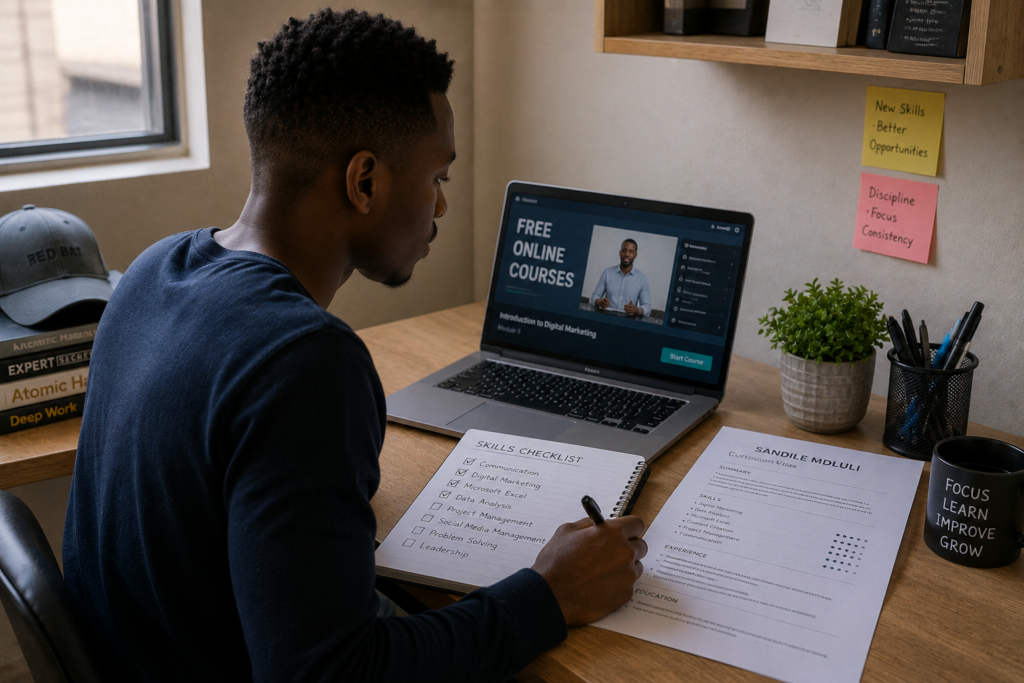
Free online courses can be useful because they show employers that you are willing to learn, adapt, and improve yourself.
In South Africa, many job seekers face the same problem: they want better opportunities, but they may not have enough recent experience, formal qualifications, or industry-specific skills. This is especially common among young people, career changers, and people who have been unemployed for a long time.
Online learning will not automatically guarantee you a job, but it can strengthen your profile when used properly.
A short course can help you understand a new field, refresh old knowledge, improve your confidence, and give you something positive to discuss in interviews. It also shows that you did not simply wait for opportunities. You used your time to build yourself.
Employers Notice Initiative
Employers often look for candidates who are proactive.
When your CV includes relevant online courses, it tells the employer that you are serious about growth. It shows that you are not only depending on past education or work experience. You are actively improving your skills for the current job market.
For example, a job seeker applying for an admin assistant position may stand out more if they have completed free courses in computer literacy, Excel, email communication, customer service, or office administration.
A person applying for a digital marketing internship may look stronger if they have completed courses in social media marketing, SEO basics, Google tools, and content creation.
The course does not need to be expensive to be valuable. What matters is whether the skill is relevant to the job.
Free Courses Help Fill Skills Gaps
Many job seekers lose confidence because they feel they do not meet every requirement in a job advert.
Maybe the advert asks for Microsoft Excel, customer service, communication skills, data capturing, basic bookkeeping, digital marketing, or project support. If you lack one or two of these skills, a free online course can help you close that gap.
This does not mean you should claim to be an expert after completing one short course. Be honest about your level. But even basic training can help you understand the language, tools, and expectations of the role.
For example, if you have never worked in an office before, completing a basic admin or computer literacy course can help you understand common workplace tasks. If you want to enter IT support, a beginner course can introduce you to hardware, software, networks, and troubleshooting.
Small improvements can make a real difference over time.
Online Learning Builds Confidence
Job searching can be emotionally draining.
After many unanswered applications, it is easy to feel stuck or discouraged. Online learning gives you something productive to focus on while you continue applying.
Every completed lesson, quiz, assignment, or certificate can rebuild your confidence. You begin to feel that you are moving forward instead of standing still.
This confidence matters in interviews. A candidate who has been learning and preparing often speaks with more clarity than someone who has not taken any action.
You can say:
“While I was applying for jobs, I used my time to complete short courses in customer service, Excel, and office communication. I wanted to strengthen my skills and prepare myself for admin opportunities.”
That answer sounds professional and responsible.
Free Courses Can Support a Career Change
If you want to move into a new career, free online courses are a low-risk way to test your interest.
Before paying for a long qualification, you can complete beginner courses to see whether the field suits you.
For example, if you are interested in coding, start with free beginner programming lessons. If you are considering digital marketing, take free courses in social media, SEO, and analytics. If you want to work in HR, start with basic human resources, recruitment, and workplace communication courses.
This helps you avoid wasting money on a career path you do not fully understand.
A free course can help you answer important questions:
Do I enjoy this subject?
Can I see myself doing this type of work?
What skills do I still need?
What entry-level jobs exist in this field?
The more you learn, the clearer your direction becomes.
Certificates Can Strengthen Your CV
Some free courses provide certificates at no cost, while others allow you to learn for free but charge for a certificate.
A certificate can be helpful, especially when it is relevant to the job you want. It gives employers proof that you completed training and took your development seriously.
However, certificates are not the only thing that matters.
Employers also want evidence that you can apply what you learned. Where possible, combine certificates with practical examples.
For example, after an Excel course, create a simple spreadsheet tracker. After a digital marketing course, create sample social media posts. After a CV writing or communication course, improve your own professional documents. Right after a data course, create a small dashboard using sample data.
This turns learning into proof.
Free Learning Helps You Stay Updated
The workplace is changing quickly.
Many jobs now require digital skills, even roles that were not traditionally considered “technology jobs.” Admin staff use online systems. Salespeople use CRM tools. Teachers use digital platforms. Entrepreneurs use social media. Customer service teams use chat systems and email support tools.
Free online courses help you keep up with these changes.
Even basic knowledge of digital tools can make you more employable. Employers generally prefer candidates who are comfortable learning new systems, using computers, communicating online, and adapting to workplace technology.
Online Courses Are Flexible
One of the biggest advantages of online learning is flexibility.
You can study:
After work
During weekends
At night
While unemployed
During quiet periods
Using a phone, tablet, or computer
This is important for South Africans who may not have the money or time to attend full-time classes.
You can start small. Even 30 minutes a day can lead to progress. Over a few weeks, you can complete a course, improve a skill, and add something valuable to your CV.
Free Courses Work Best With Action
Free online courses are useful, but only when you use them properly.
Do not simply collect certificates and expect employers to be impressed. Choose courses that match your goals, complete them properly, practise what you learn, and update your CV with the most relevant ones.
The real value comes from combining learning with action.
Learn the skill.
Practise the skill.
Add it to your CV.
Use it in applications.
Discuss it confidently in interviews.
That is how free online courses can improve your job prospects.
Best Free Online Course Platforms for South African Job Seekers
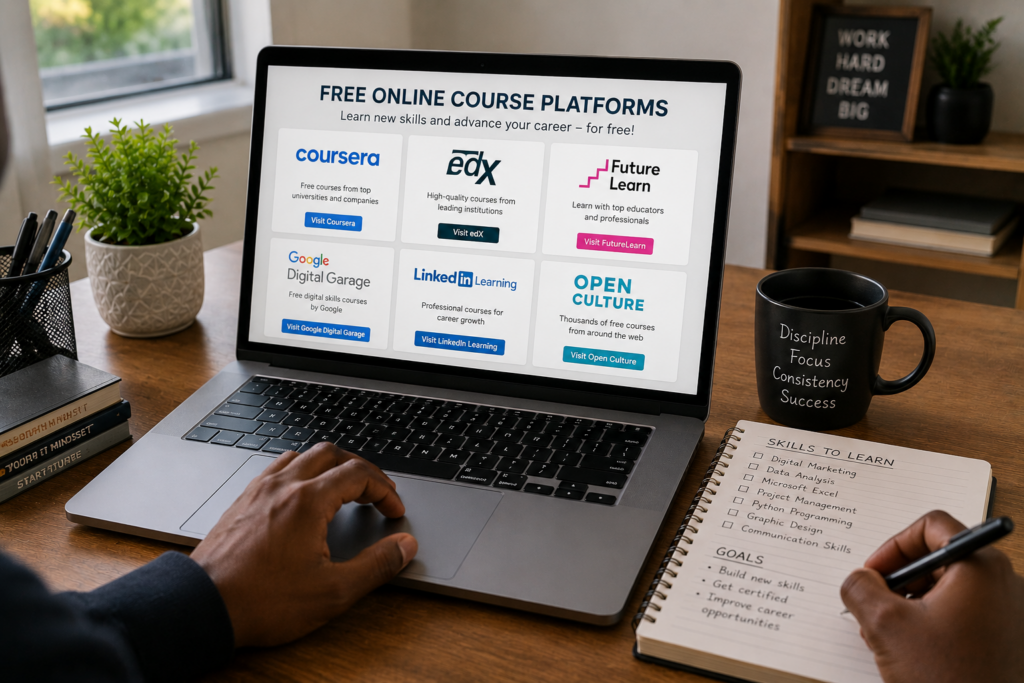
There are many online learning platforms, but job seekers should focus on platforms that teach practical, workplace-ready skills. The best free courses are not always the longest or most popular. They are the ones that help you qualify for real opportunities, improve your CV, and prepare you for interviews.
Below are some useful platforms South African job seekers can explore.
Google Digital Skills / Google Digital Garage
Even today, Google offers free training in digital skills, online marketing, career development, data, technology, and business-related topics. Google Digital Garage is known for offering free online training and certificates in selected courses, especially around digital marketing and online business skills.
This is useful for job seekers who want to apply for roles such as:
Digital marketing assistant
Social media assistant
Sales representative
Content creator
Small business assistant
Admin support
Online customer service agent
A good starting point is digital marketing because many South African businesses now need help with social media, Google Business Profiles, online advertising, content writing, and customer communication.
Microsoft Learn
Microsoft Learn is useful for people who want to improve their digital and technical skills. It includes free learning paths on Microsoft products, cloud computing, AI, data, security, business applications, and productivity tools.
This can help job seekers who want to move into:
IT support
Office administration
Data capturing
Cloud computing
Business analysis
Technical support
Cybersecurity basics
Even if you are not applying for a technical job, Microsoft skills are useful because many workplaces use Microsoft tools daily. Excel, Word, Outlook, Teams, PowerPoint, and basic data skills can improve your confidence in office-related roles.
Cisco Networking Academy
The Cisco Networking Academy is helpful for job seekers interested in IT, networking, cybersecurity, and computer support. Cisco is well known in the technology industry, and its learning platform includes beginner-friendly courses that introduce networking, cybersecurity, and digital technology concepts. Cisco Packet Tracer is also widely used as a learning tool for networking students.
This platform is useful for people who want to explore careers such as:
IT support technician
Network support assistant
Cybersecurity beginner
Help desk agent
Technical support consultant
For someone who has no IT background, beginner courses can help you understand whether the field suits you before paying for advanced certification.
Coursera
Coursera offers courses from universities and companies around the world. Some courses can be accessed for free in limited ways, while certificates and graded assignments may require payment depending on the course or programme. Coursera works with many universities and organisations, and it is often used for professional certificates and career-related learning.
Coursera can be useful for job seekers interested in:
Data analysis
Project management
Business communication
Digital marketing
IT support
AI skills
Career development
When using Coursera, always check whether the course is fully free, audit-only, or requires payment for the certificate. The learning itself may still be valuable even when the certificate is paid.
GCFGlobal
GCFGlobal is a strong option for beginners who need basic digital literacy and workplace skills. It offers free self-paced tutorials in technology, Microsoft Office, work and career, reading, maths, and everyday life skills.
This is especially useful for job seekers who need to improve:
Computer basics
Email skills
Microsoft Word
Microsoft Excel
PowerPoint
Typing confidence
Job search skills
Workplace communication
For someone applying for admin, retail, receptionist, data capturing, call centre, or entry-level office roles, GCFGlobal can be a practical starting point.
LinkedIn Learning Free Trials and Free Courses
LinkedIn Learning is normally a paid platform, but it sometimes offers selected free courses or free trial access. It is useful because many courses are linked to workplace skills such as communication, leadership, Excel, productivity, customer service, and job search preparation.
Job seekers can use it to improve their LinkedIn profiles, learn interview skills, and gain short certificates that can be displayed on LinkedIn.
Before using a free trial, remember to check the payment terms carefully so you do not get charged unexpectedly.
Alison
Alison is popular among job seekers because it offers many free online courses in business, IT, health and safety, customer service, administration, and personal development. The learning is free, although certificates or diplomas may require payment.
Useful areas include:
Office administration
Customer service
Human resources basics
Workplace safety
Computer skills
Business management
Sales skills
Alison can be helpful when you want broad beginner-level knowledge, but you should choose courses carefully and focus on those that match the jobs you are applying for.
IBM SkillsBuild
IBM SkillsBuild offers free learning resources focused on digital skills, professional development, AI, cybersecurity, data, cloud, and workplace readiness. This can be especially useful for young job seekers, unemployed graduates, and people interested in technology careers.
Courses may help with:
Professional skills
Digital literacy
Cybersecurity basics
AI awareness
Data fundamentals
Career readiness
For someone who wants to enter the digital economy but does not know where to start, IBM SkillsBuild can provide a structured learning path.
Which Platform Should You Start With?
The best platform depends on your goal.
If you want an office job, start with computer literacy, Excel, email communication, and customer service.
And If you want IT support, start with Microsoft Learn, Cisco Networking Academy, IBM SkillsBuild, and beginner computer troubleshooting courses.
If you want digital marketing, start with Google Digital Garage, social media courses, SEO basics, and content creation.
If you want admin or receptionist work, focus on Microsoft Office, communication, data capturing, filing systems, and workplace professionalism.
The goal is not to join every platform at once. Choose one career direction, complete two or three relevant courses, practise the skills, then update your CV.
The Best Free Courses for Different Career Paths
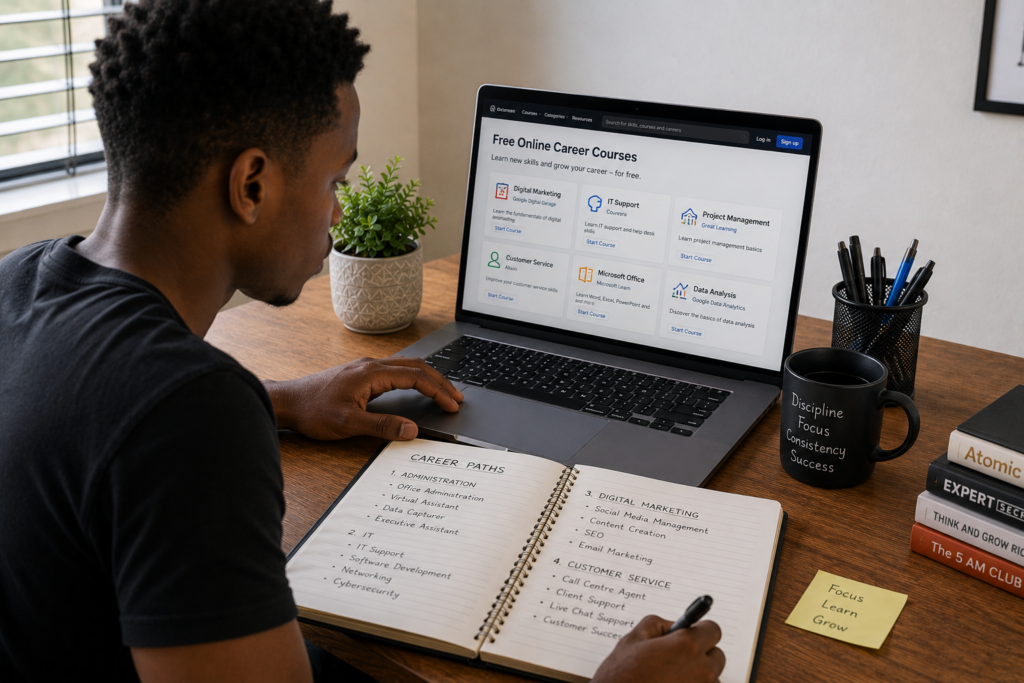
Choosing the right course is just as important as choosing the right platform.
Many job seekers make the mistake of completing dozens of unrelated courses because they are free. While learning is always valuable, employers are usually more interested in seeing that your training matches the job you are applying for.
Instead of collecting random certificates, focus on courses that build a clear career path.
Administration and Office Support
Administration remains one of the most common career paths in South Africa. Employers look for candidates who are organised, professional, and comfortable using computers.
Useful free courses include:
- Microsoft Word
- Microsoft Excel
- Microsoft Outlook
- Office Administration
- Business Communication
- Email Etiquette
- Time Management
- Data Capturing
- Customer Service
- Filing and Record Management
These skills are valuable for roles such as:
Administrative Assistant
Receptionist
Office Administrator
Personal Assistant
Data Capturer
Clerk
Even basic Excel skills can make a significant difference when applying for office-based positions.
Customer Service and Call Centre Jobs
South Africa has a large customer service and business process outsourcing (BPO) industry. Many employers provide job-specific training, but having a foundation in customer service can strengthen your application.
Useful courses include:
- Customer Service Fundamentals
- Communication Skills
- Conflict Resolution
- Telephone Etiquette
- Business Writing
- Emotional Intelligence
- Professional Communication
These courses can prepare you for careers such as:
Call Centre Agent
Customer Service Consultant
Help Desk Agent
Client Support Officer
Sales Consultant
Strong communication skills are often more important than technical knowledge in these roles.
Information Technology (IT)
Technology continues to create new career opportunities across South Africa.
Even if you have no previous IT experience, beginner courses can help you understand different career paths before specialising.
Good starting topics include:
- Computer Fundamentals
- Networking Basics
- Cybersecurity Fundamentals
- Cloud Computing
- Microsoft Windows
- IT Support
- Artificial Intelligence Basics
- Data Fundamentals
Possible career paths include:
IT Support Technician
Help Desk Support
Junior Network Technician
Cybersecurity Analyst
Cloud Support Assistant
Systems Administrator
You do not need to learn everything at once. Start with the basics before moving into specialised areas.
Digital Marketing
Almost every business now has an online presence.
This means digital marketing skills are valuable across many industries.
Useful beginner courses include:
- Social Media Marketing
- Search Engine Optimisation (SEO)
- Content Marketing
- Google Analytics
- Email Marketing
- Google Ads Basics
- Online Branding
These skills may lead to opportunities such as:
Digital Marketing Assistant
Social Media Coordinator
Content Creator
Marketing Intern
SEO Assistant
They are also useful for people who want to start freelancing or promote their own businesses.
Human Resources
Human Resources is a popular career choice for people who enjoy working with others and supporting workplace development.
Beginner courses may include:
- Introduction to Human Resources
- Recruitment Basics
- Workplace Communication
- Labour Relations Fundamentals
- Employee Records Management
- Performance Management
These courses can support applications for:
HR Assistant
Recruitment Administrator
Training Coordinator
Payroll Assistant
Although many HR positions require formal qualifications, short courses help demonstrate your interest in the profession.
Project Management
Project management skills are useful in almost every industry, including construction, IT, healthcare, manufacturing, education, logistics, and government.
Useful topics include:
- Project Planning
- Risk Management
- Communication
- Scheduling
- Budgeting Basics
- Team Leadership
Even if you do not become a project manager immediately, these skills improve your ability to organise work and manage responsibilities.
Entrepreneurship and Small Business
Not every job seeker plans to become an employee.
Some South Africans want to start small businesses or work independently.
Useful courses include:
- Business Planning
- Entrepreneurship
- Sales
- Financial Management
- Marketing
- Customer Service
- Basic Accounting
These skills can help you start a side business while continuing your job search.
Soft Skills Every Employer Values
Technical skills help you qualify for a job.
Soft skills help you keep the job.
Regardless of your career choice, employers consistently value:
Communication
Problem-solving
Critical thinking
Time management
Adaptability
Teamwork
Professionalism
Leadership
Work ethic
Emotional intelligence
Many free online platforms now offer dedicated courses covering these workplace skills.
Although they may seem less exciting than technical courses, they often make the biggest difference during interviews and in everyday work.
Choose Quality Over Quantity
Completing twenty unrelated courses does not necessarily make your CV stronger.
Instead, aim to complete three to five well-chosen courses that directly support your career goal.
For example, someone applying for an administration role might complete:
- Microsoft Excel
- Microsoft Word
- Office Administration
- Business Communication
- Customer Service
Those five courses create a clear story.
The employer immediately understands the direction you are taking.
That is far more effective than having certificates in cooking, photography, coding, first aid, graphic design, accounting, and social media with no clear career focus.
Remember, employers are not only looking for people who enjoy learning.
They are looking for candidates who have prepared themselves for the specific role they are hiring for.
Free Courses That Are Especially Useful for Unemployed Job Seekers
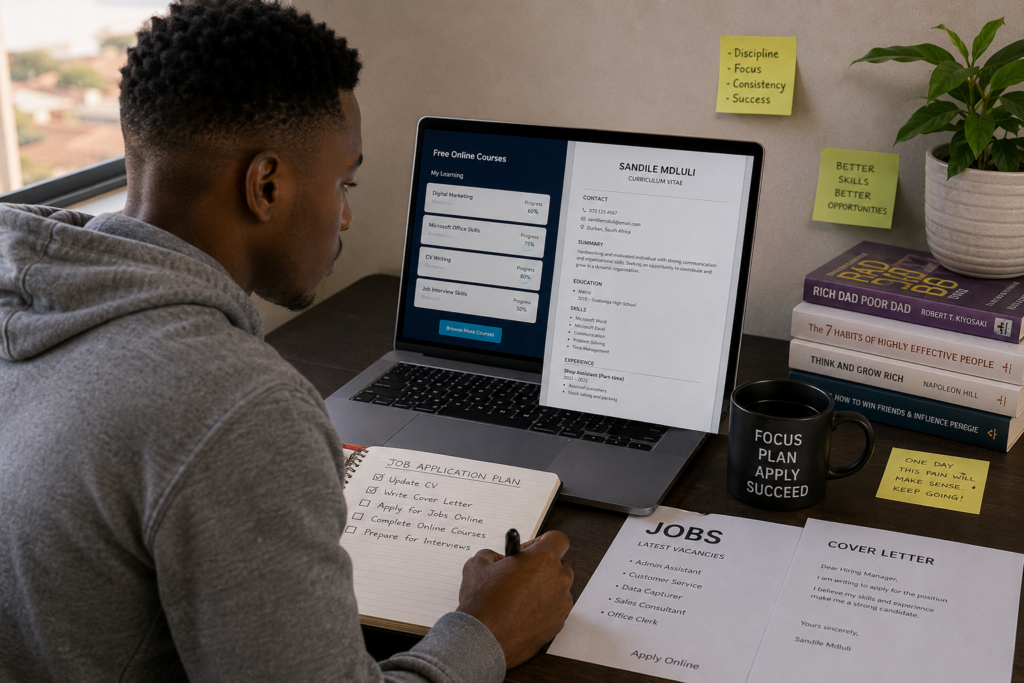
When you are unemployed, your time becomes one of your most valuable resources.
It can be tempting to spend every day only sending applications, but job hunting works better when it is combined with skill development. While you continue applying for jobs, free online courses can help you improve your CV, prepare for interviews, and build confidence.
The aim is not to keep yourself busy for the sake of it. The aim is to become more employable.
Computer Literacy Courses
Computer literacy is one of the most important skills for modern job seekers.
Even jobs that are not office-based often require some digital ability. Employers may expect you to send emails, complete online forms, use workplace systems, upload documents, or communicate through digital platforms.
Useful computer literacy topics include:
- Using a computer
- Typing basics
- Email communication
- Internet research
- Microsoft Word
- Microsoft Excel
- PowerPoint
- Online safety
- File management
For South African job seekers applying for admin, retail, call centre, data capturing, receptionist, school assistant, or office support roles, basic computer skills can make a real difference.
Microsoft Excel Courses
Excel is one of the most useful workplace tools to learn.
You do not need to become an advanced expert immediately. Start with the basics:
- Creating spreadsheets
- Formatting cells
- Sorting and filtering data
- Simple formulas
- Tables
- Basic charts
- Budget trackers
- Attendance registers
These skills are useful in many roles, including administration, sales, stock control, finance support, HR, logistics, and data capturing.
A simple Excel course can also give you practical examples to mention in interviews.
For example:
“I completed a beginner Excel course and practised by creating a basic monthly expense tracker and attendance register.”
That sounds better than simply saying, “I know Excel.”
Customer Service Courses
Customer service skills are valuable in many industries.
South Africa has many roles where employees interact with customers, clients, patients, students, callers, suppliers, or members of the public.
Customer service courses can help you learn how to:
- Communicate professionally
- Handle complaints
- Stay calm under pressure
- Listen actively
- Solve problems
- Manage difficult conversations
- Represent a company properly
These skills are useful for call centre jobs, retail positions, reception work, hospitality, banking, insurance, sales, and support roles.
Communication Skills Courses
Good communication is one of the most important employability skills.
Many people lose opportunities not because they lack ability, but because they struggle to express themselves clearly in emails, interviews, CVs, or workplace conversations.
Free communication courses can help you improve:
- Business writing
- Email etiquette
- Interview communication
- Presentation skills
- Listening skills
- Professional language
- Confidence when speaking
These skills are useful in every industry.
CV Writing and Interview Preparation Courses
Some online platforms offer free courses or tutorials on CV writing, job applications, LinkedIn profiles, and interview preparation.
These are useful because many job seekers apply for jobs without understanding how employers screen applications.
A good CV course can help you learn how to:
- Structure your CV
- Highlight relevant skills
- Write a professional summary
- Avoid common CV mistakes
- Use keywords from job adverts
- Explain gaps in employment
- Present online courses properly
Interview preparation courses can help you answer common questions, speak confidently, and explain your strengths clearly.
Digital Skills Courses
Digital skills are no longer only for IT professionals.
Many workplaces now use online tools for communication, marketing, records, sales, payments, reporting, and customer service.
Useful digital skills include:
- Using Google Workspace
- Online collaboration
- Social media basics
- Digital marketing basics
- Online research
- Cybersecurity awareness
- Cloud storage
- Video meeting tools
Even a basic digital skills certificate can strengthen your CV, especially if you are applying for office, sales, admin, marketing, or remote work opportunities.
Workplace Readiness Courses
Workplace readiness courses help job seekers understand professional behaviour.
These courses may cover:
- Time management
- Workplace ethics
- Teamwork
- Conflict management
- Professional conduct
- Problem-solving
- Adaptability
- Personal branding
These topics may sound simple, but they matter. Employers want people who can arrive on time, communicate respectfully, take instructions, work with others, and handle responsibility.
For young job seekers with little work experience, workplace readiness training can be especially useful.
Basic Financial Literacy Courses
Financial literacy may not be required for every job, but it is valuable for personal growth.
Learning how to budget, manage debt, save money, and understand payslips can help you make better decisions once you start earning.
It can also help people who want to start side hustles or small businesses while job hunting.
How to Choose Courses While Unemployed
Do not try to complete everything at once.
Choose courses based on the jobs you are applying for.
For example, if you are applying for admin jobs, focus on computer literacy, Excel, business communication, customer service, and office administration.
If you are applying for call centre jobs, focus on customer service, telephone etiquette, communication skills, conflict resolution, and computer basics.
If you are applying for IT support roles, focus on computer fundamentals, networking basics, troubleshooting, cybersecurity awareness, and customer support.
A focused learning plan is better than random learning.
Best Free IT and Digital Skills Courses for Job Seekers
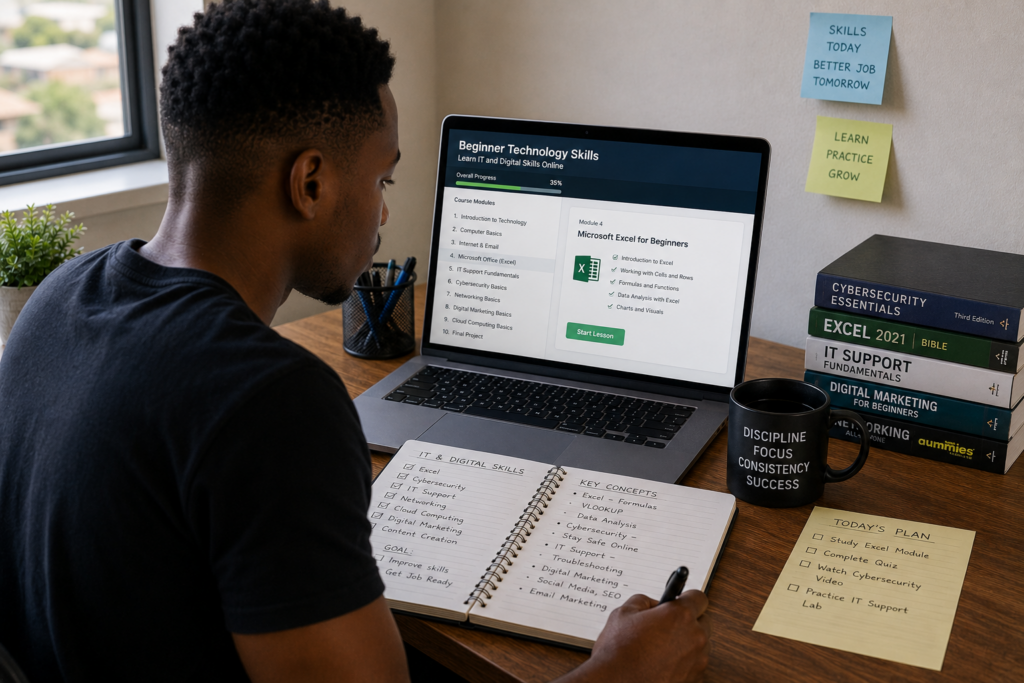
IT and digital skills are becoming more important in almost every industry.
You do not have to become a software developer to benefit from digital learning. Even basic technology skills can help you apply for admin jobs, call centre jobs, remote work, sales roles, data capturing, customer support, and entry-level IT positions.
For job seekers in South Africa, IT and digital courses are useful because many employers want people who can learn systems quickly, use computers confidently, communicate online, and solve basic technical problems.
Computer Fundamentals
Computer fundamentals are the best starting point for beginners.
These courses usually teach:
- Parts of a computer
- How operating systems work
- File management
- Internet browsing
- Email basics
- Installing software
- Basic troubleshooting
- Online safety
This is useful for people who feel nervous around computers or have not used workplace systems before.
Once you understand the basics, you can move into more advanced topics like Microsoft Office, networking, cybersecurity, or data analysis.
Microsoft Office Skills
Microsoft Office skills are useful in many jobs.
For office-based roles, employers often expect you to know Word, Excel, Outlook, PowerPoint, and sometimes Teams.
Microsoft Word is useful for letters, reports, forms, and documents.
Excel is useful for data capturing, budgets, stock lists, attendance registers, invoices, and reports.
Outlook is useful for professional email communication and scheduling.
PowerPoint is useful for presentations, proposals, training material, and meetings.
Microsoft Teams is useful for online meetings, workplace communication, and remote collaboration.
A job seeker applying for admin or office support roles should prioritise Microsoft Office before moving into highly specialised courses.
Cybersecurity Awareness
Cybersecurity is not only for IT specialists.
Every employee who uses email, online systems, phones, laptops, or company accounts needs basic cybersecurity awareness.
Beginner cybersecurity courses teach topics such as:
- Password safety
- Phishing emails
- Online scams
- Safe browsing
- Protecting personal information
- Device security
- Social engineering
This is useful for job seekers because employers want people who can use technology responsibly. It is also helpful in your personal life because online scams are common.
Networking Basics
Networking basics are important for people interested in IT support or technical roles.
These courses usually cover:
- What networks are
- Routers and switches
- IP addresses
- Wi-Fi basics
- Internet connectivity
- Troubleshooting common network problems
For someone who wants to become an IT support technician, networking is a strong foundation. You do not need to understand everything immediately. Start with beginner lessons, practise the concepts, and slowly build confidence.
IT Support Fundamentals
IT support courses are useful because they connect technical knowledge with customer service.
Many entry-level IT jobs involve helping users solve basic problems, such as login issues, slow computers, printer problems, email setup, software installation, and internet connection errors.
Useful topics include:
- Troubleshooting
- Hardware basics
- Software basics
- Operating systems
- User support
- Ticketing systems
- Professional communication
A person with both IT knowledge and customer service skills can be more attractive to employers than someone who only understands technology but cannot communicate clearly.
Data Skills
Data skills are becoming useful in many industries.
You do not have to be a data scientist to benefit from learning data basics. Many jobs involve collecting, organising, checking, and reporting information.
Beginner data courses may include:
- Spreadsheets
- Data cleaning
- Basic analysis
- Charts
- Dashboards
- Data visualisation
- Reporting
Excel is usually the best place to start. Once you are comfortable, you can explore Google Sheets, Power BI, SQL, or beginner data analysis courses.
These skills can support roles in admin, finance support, sales, operations, logistics, HR, and business reporting.
Digital Marketing Basics
Digital marketing is useful for job seekers who want to work in marketing, sales, content creation, small business support, or freelancing.
Beginner courses usually cover:
- Social media marketing
- Search engine optimisation
- Content marketing
- Email marketing
- Online advertising
- Analytics
- Branding
Many small businesses need help with Facebook pages, Instagram content, WhatsApp marketing, Google Business Profiles, and basic online campaigns.
If you complete a digital marketing course, create practical examples. Build a sample content calendar, write social media captions, design simple post ideas, or create a basic marketing plan for a small business.
Artificial Intelligence Basics
AI tools are becoming part of modern work.
Job seekers do not need to become AI experts, but basic AI literacy can help you understand how these tools are used for writing, research, planning, customer service, data analysis, and productivity.
Useful beginner topics include:
- What AI is
- How AI tools work
- Responsible AI use
- Prompt writing
- Productivity with AI
- AI ethics
- AI in the workplace
This can be helpful for admin workers, marketers, students, entrepreneurs, writers, researchers, and professionals who want to stay updated.
Build a Simple Digital Skills Learning Plan
If you are unsure where to start, use a simple pathway.
Start with computer fundamentals.
Then learn Microsoft Word and Excel.
After that, choose one direction:
IT support
Digital marketing
Data skills
Cybersecurity
AI basics
Do not try to learn everything at once. A focused path helps you stay consistent and avoid confusion.
For example, a beginner who wants to enter IT support could follow this plan:
Computer fundamentals
Networking basics
Cybersecurity awareness
IT support fundamentals
Customer service
A person who wants admin work could follow this plan:
Computer literacy
Microsoft Word
Microsoft Excel
Email communication
Office administration
A person interested in digital marketing could follow this plan:
Digital marketing basics
Social media marketing
Content writing
SEO basics
Analytics basics
The right path depends on the job you want.
Free Business, Admin and Workplace Skills Courses
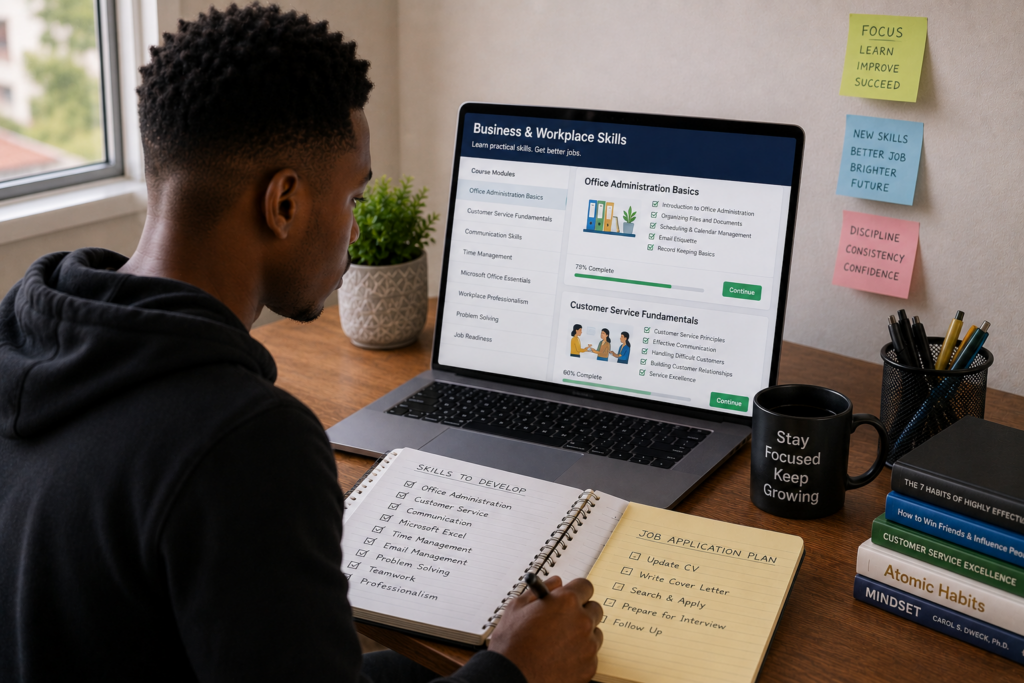
Not every job seeker wants to enter IT or digital marketing.
Many South Africans are looking for practical roles in administration, retail, sales, customer service, finance support, reception, operations, logistics, human resources, or general office work. For these careers, business and workplace skills can be just as important as technical knowledge.
These courses help you understand how companies operate, how to communicate professionally, and how to handle everyday responsibilities in a working environment.
Office Administration
Office administration courses are useful for people applying for admin assistant, clerk, receptionist, data capturer, school assistant, or office support roles.
These courses may cover:
- Filing systems
- Record keeping
- Professional communication
- Scheduling
- Office procedures
- Basic reporting
- Data capturing
- Meeting preparation
- Document management
Administration is about reliability and organisation. Employers want someone who can keep information accurate, communicate clearly, follow instructions, and support the smooth running of the office.
Business Communication
Business communication is one of the most valuable skills for job seekers.
It teaches you how to write professional emails, speak clearly, listen properly, ask good questions, and communicate with customers, managers, colleagues, and suppliers.
This skill is useful in almost every job.
A person who can communicate professionally is often easier to train and easier to trust with responsibility.
Customer Service
Customer service courses are useful for retail, call centre, receptionist, hospitality, sales, banking, insurance, and support roles.
They usually teach how to:
- Greet customers professionally
- Handle complaints
- Listen actively
- Solve problems
- Stay calm under pressure
- Communicate with respect
- Represent a company properly
Many employers prefer candidates who can deal with people patiently and professionally.
Sales and Marketing Basics
Sales skills are useful even outside traditional sales jobs.
Many businesses need people who can explain products, understand customer needs, follow up on leads, and help generate income.
Beginner sales courses may cover:
- Understanding customers
- Building trust
- Handling objections
- Product knowledge
- Closing sales
- Follow-up communication
- Basic marketing principles
These skills are useful for sales consultant roles, retail jobs, call centre sales, insurance, real estate, small business, and entrepreneurship.
Human Resources Basics
Human resources courses are useful for job seekers who enjoy working with people and supporting workplace processes.
Beginner HR courses may introduce:
- Recruitment
- Employee records
- Workplace policies
- Training and development
- Performance management
- Labour relations basics
- Onboarding
Many HR jobs require formal qualifications, but free beginner courses can help you understand the field before committing to longer studies.
Project Management Basics
Project management skills are useful in many industries.
Even if you are not applying for a project manager role, basic project skills can help you organise work better.
Courses may cover:
- Planning tasks
- Setting deadlines
- Managing resources
- Communicating progress
- Identifying risks
- Tracking results
- Working with teams
These skills are useful in administration, construction, events, IT, logistics, education, operations, and business support.
Basic Accounting and Finance
Basic finance courses are useful for job seekers interested in admin, bookkeeping, business support, finance assistant roles, or entrepreneurship.
Useful topics include:
- Invoices
- Receipts
- Budgets
- Income and expenses
- Basic bookkeeping
- Financial records
- Cash flow
- Payroll basics
You do not need to become an accountant immediately. Even basic understanding of financial records can improve your confidence in office and business roles.
Workplace Ethics and Professionalism
Workplace professionalism is often overlooked, but it matters.
Employers want people who are dependable, honest, respectful, and able to work with others.
Courses in workplace readiness may cover:
- Time management
- Responsibility
- Teamwork
- Respectful communication
- Conflict handling
- Work ethic
- Personal presentation
- Accountability
These skills are especially useful for first-time job seekers who may not yet understand workplace expectations.
Leadership and Teamwork
Leadership is not only for managers.
Even junior employees can show leadership by taking responsibility, helping others, solving problems, and staying calm under pressure.
Free leadership and teamwork courses can help you understand:
- How teams work
- How to motivate others
- How to solve conflict
- How to communicate under pressure
- How to take initiative
- How to support shared goals
These skills can help you grow after you get hired.
Build a Workplace Skills Package
A strong workplace learning plan could include:
- Business communication
- Customer service
- Microsoft Excel
- Office administration
- Time management
- Workplace professionalism
This combination is useful for many entry-level and junior roles.
For example, if you are applying for a receptionist position, you can show that you have prepared yourself by learning communication, customer service, email etiquette, and office administration.
If you are applying for a sales role, you can focus on customer service, sales basics, communication, digital marketing, and negotiation.
The more your courses match your target job, the stronger your CV becomes.
How to Choose the Right Free Online Course
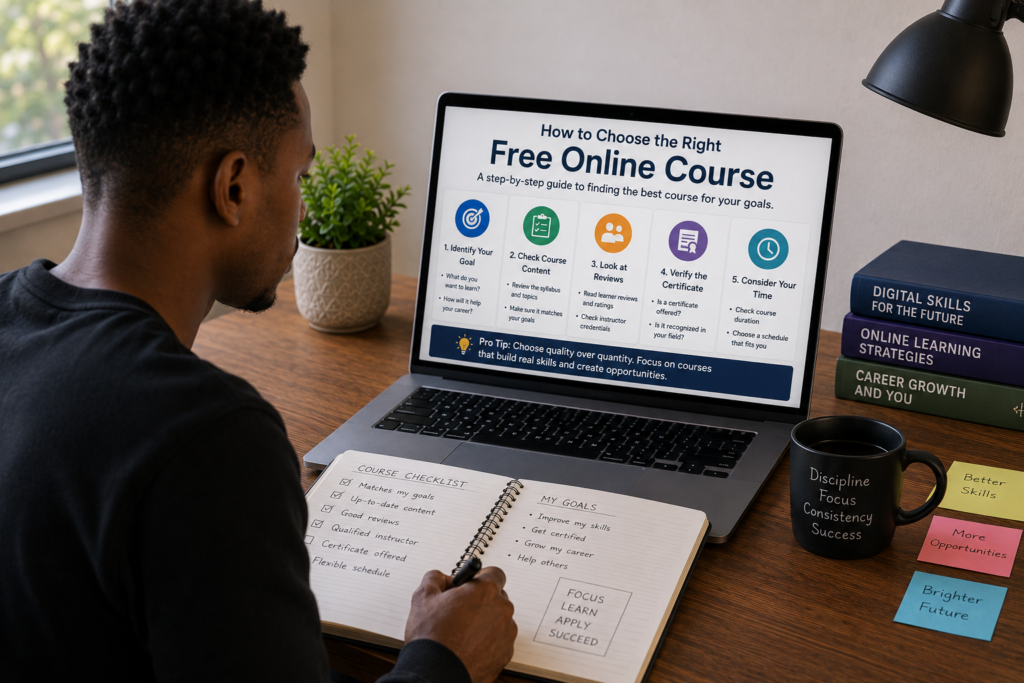
With so many free online courses available, it is easy to feel overwhelmed.
One platform may offer hundreds of courses. Another may promise certificates, diplomas, badges, career paths, or professional training. As a job seeker, your goal is not to study everything. Your goal is to choose courses that improve your chances of getting hired.
A good course should match your career goal, improve a useful skill, and give you something practical to add to your CV or discuss in an interview.
Start With the Job You Want
Before choosing a course, look at the job adverts you are interested in.
Read five to ten adverts for similar roles and pay attention to the repeated requirements. These repeated skills are usually the most important.
For example, admin job adverts may often mention:
- Microsoft Excel
- Data capturing
- Communication
- Filing
- Email skills
- Attention to detail
- Customer service
Call centre adverts may mention:
- Communication skills
- Computer literacy
- Customer service
- Problem-solving
- Sales ability
- Conflict handling
IT support adverts may mention:
- Troubleshooting
- Networking basics
- Windows
- Hardware and software support
- Help desk experience
- Customer support
Once you understand what employers are asking for, choose courses that help you build those skills.
Check Whether the Course Is Beginner-Friendly
Some courses are advertised as “free,” but they may assume that you already have experience.
If you are new to a subject, start with beginner-level training. This helps you build a foundation instead of becoming frustrated.
For example, do not start with advanced cybersecurity if you do not yet understand computer basics. Do not start with advanced Excel formulas if you still struggle with simple spreadsheets.
A strong learning path starts with basics and builds slowly.
Look at the Course Content
Before enrolling, check what the course actually covers.
A good course should clearly show:
- Course topics
- Learning outcomes
- Estimated duration
- Skill level
- Whether quizzes or assessments are included
- Whether a certificate is available
- Whether the certificate is free or paid
This helps you avoid wasting time on courses that sound impressive but do not teach what you need.
Prefer Practical Courses
Practical courses are usually more useful than courses that only explain theory.
A practical course teaches you how to do something.
For example:
- Create a spreadsheet
- Write a professional email
- Handle a customer complaint
- Build a simple CV
- Prepare for an interview
- Create a social media calendar
- Troubleshoot a basic computer problem
These skills can be used immediately.
When possible, choose courses that include exercises, examples, quizzes, assignments, or projects.
Check the Platform’s Reputation
You do not need every course to come from a university, but the platform should still be trustworthy.
Well-known platforms such as Google, Microsoft, Cisco, IBM, Coursera, edX, Alison, and GCFGlobal are generally more recognisable than unknown websites.
Employers may not know every platform, but recognised names can make your CV look more credible.
Understand the Certificate Rules
Some platforms allow you to learn for free but charge for certificates. Others offer certificates completely free.
Before starting, check the certificate terms.
Ask:
Is the course free?
Is the certificate free?
Do I need to pass an assessment?
Can I download the certificate?
Does the certificate expire?
Can I add it to LinkedIn?
Even when a certificate is paid, the free learning may still be useful. However, if you specifically need a free certificate, confirm that before spending time on the course.
Avoid Course Collecting
Course collecting happens when a person keeps enrolling in many courses but never applies the knowledge.
This can make you feel productive without producing real progress.
It is better to complete three relevant courses and practise the skills than to complete twenty unrelated courses that do not support your job search.
For example, if your goal is office administration, focus on Excel, Word, office communication, customer service, and admin basics. That creates a clear path.
Choose Courses You Can Actually Finish
A course only helps you if you complete it properly.
Be realistic about your time, data, concentration, and responsibilities. If you only have one hour per day, choose a course that fits your schedule.
Short courses can still be valuable when they teach useful skills.
Consistency matters more than trying to do too much at once.
Match Courses to Your CV
Before choosing a course, ask yourself:
“Where will this fit on my CV?”
If you cannot connect the course to your target job, it may not be the best priority right now.
For example, a course in customer service fits well for retail, call centre, reception, hospitality, sales, and admin roles.
A course in Excel fits well for admin, finance, HR, logistics, data capturing, and operations roles.
A course in cybersecurity basics fits well for IT support, help desk, data protection, and digital roles.
Choose training that strengthens your story.
How to Add Free Online Courses to Your CV
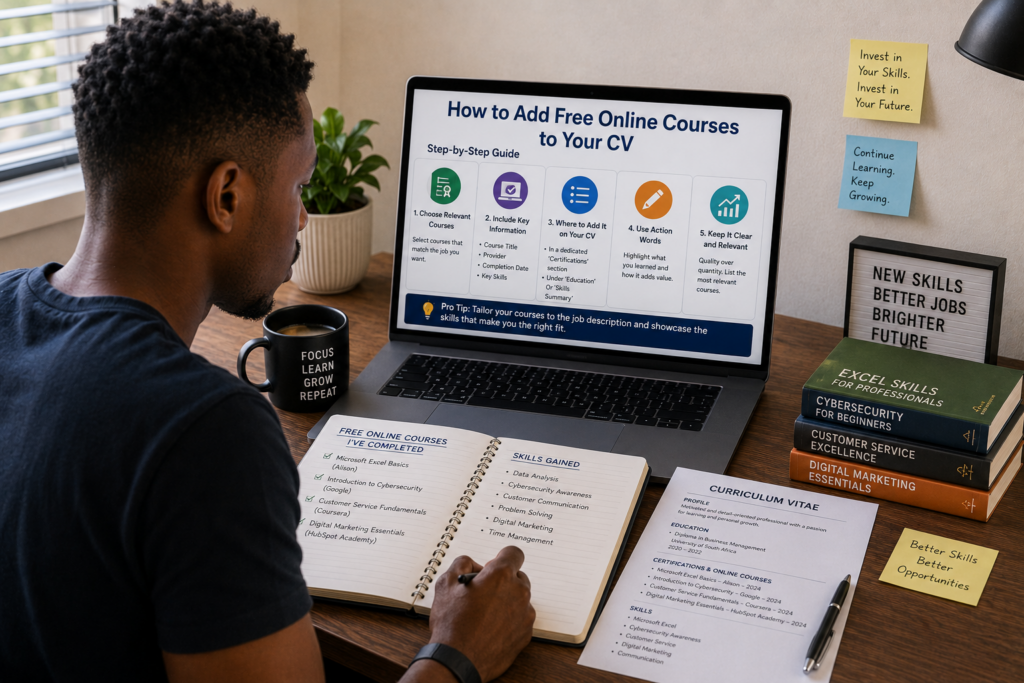
Completing a free online course is useful, but how you present it on your CV also matters.
Many job seekers either hide their online courses completely or list too many of them in a way that looks messy. The goal is to make your CV stronger, not overcrowded.
Online courses should show that you are serious about learning and that you have built skills relevant to the job.
Create a Separate Section
Add a simple section called:
Courses and Certifications
or
Relevant Training
Place this section after your education or skills section, depending on your CV layout.
For example:
Relevant Training
Microsoft Excel for Beginners — 2026
Customer Service Fundamentals — 2026
Business Communication — 2026
Introduction to Digital Marketing — 2026
Keep it neat and easy to read.
Include Only Relevant Courses
Do not list every course you have ever completed.
If you are applying for an admin job, include Excel, Word, office administration, communication, customer service, and data capturing courses.
And If you are applying for IT support, include computer fundamentals, networking basics, cybersecurity awareness, and troubleshooting courses.
If you are applying for digital marketing, include SEO, social media marketing, content marketing, analytics, and Google tools.
Your CV should match the job.
Mention the Platform
Include the course provider where possible.
For example:
Microsoft Excel for Beginners — Microsoft Learn, 2026
Fundamentals of Digital Marketing — Google Digital Garage, 2026
Introduction to Cybersecurity — Cisco Networking Academy, 2026
This helps employers understand where the training came from.
Add Certificates Carefully
If you received a certificate, you can mention it.
For example:
Customer Service Skills Certificate — Alison, 2026
Digital Marketing Certificate — Google Digital Garage, 2026
If the course did not provide a certificate, you can still include it as training, especially if it is relevant. Just do not claim a certificate if you did not receive one.
Connect Courses to Your Skills Section
Your courses should support the skills listed on your CV.
For example, if your skills section includes “Microsoft Excel,” your training section can show that you completed an Excel course. If your skills section includes “customer service,” your training can support that claim.
This makes your CV more believable.
Use Courses in Your Professional Summary
If you are a beginner or changing careers, you can mention your online learning in your CV summary.
Example:
“Motivated entry-level job seeker with recent training in Microsoft Excel, customer service, business communication, and office administration. Strong interest in administrative support roles and committed to continuous learning.”
This helps employers quickly understand your direction.
Do Not Exaggerate
Completing one short course does not make you an expert.
Be honest about your level. Use words like:
Beginner knowledge
Basic understanding
Introductory training
Foundational skills
Practical exposure
Honesty builds trust.
Add Practical Examples Where Possible
If you used what you learned to create something practical, mention it under a projects section.
For example:
Created a basic Excel expense tracker after completing a beginner Excel course.
Prepared a sample social media content calendar after completing digital marketing training.
Created a professional CV and cover letter after completing job readiness training.
This shows that you can apply knowledge, not only collect certificates.
Keep the CV Clean
A CV with too many courses can look unfocused.
Choose the most relevant three to six courses for each job application. You can keep a longer list for yourself, but your CV should only include what supports the role.
A focused CV is usually stronger than a crowded CV.
How to Use Free Courses During Your Job Search
Free online courses are most useful when they become part of your job search strategy.
Studying alone is not enough. You still need to apply for jobs, update your CV, prepare for interviews, and build practical examples. The course should support your job search, not replace it.
A balanced approach works best.
Create a Weekly Learning Plan
Set a simple weekly schedule for your learning.
For example:
Monday to Wednesday: Study one course module
Thursday: Practise what you learned
Friday: Update your CV or LinkedIn profile
Weekend: Apply for jobs and prepare interview answers
You do not need to study all day. Even 30 to 60 minutes per day can help if you stay consistent.
Apply What You Learn Immediately
After completing a lesson, try to use the skill.
If you learn Excel, create a simple spreadsheet.
And if you learn customer service, practise answering difficult customer questions.
If you learn digital marketing, create a sample content calendar.
If you learn interview skills, write answers to common interview questions.
This helps turn theory into real ability.
Use Courses to Improve Your Job Applications
When applying for jobs, adjust your CV based on the role.
-If the job advert asks for Excel, make sure your Excel course appears clearly.
And If the advert asks for communication skills, mention your business communication training.
If the advert asks for customer service, include relevant customer service courses and examples.
This makes your application more targeted.
Mention Courses in Interviews
Online courses can give you something positive to talk about during interviews.
For example:
“While job searching, I completed a free customer service course to improve how I handle clients and complaints.”
Or:
“I recently completed beginner Excel training and practised by creating a simple monthly tracker.”
These answers show initiative and preparation.
Keep Learning While Applying
Do not wait until you finish every course before applying for jobs.
Apply while you learn.
Many job seekers delay applications because they feel they are not ready. But the job search process itself teaches you what employers want. You may notice repeated skills in adverts, then choose courses that match those needs.
Learning and applying should happen together.
Track Your Progress
Keep a simple record of:
- Courses completed
- Certificates earned
- Skills learned
- Practical examples created
- Jobs applied for
- Interview feedback
This helps you stay organised and motivated.
It also gives you clear information when updating your CV.
Build a Small Portfolio
A portfolio is not only for designers.
You can create a basic folder with examples of your work.
For admin roles, include sample spreadsheets, reports, letters, or meeting minutes.
And For digital marketing, include sample posts, captions, content calendars, or campaign ideas.
For IT support, include notes from troubleshooting exercises or screenshots of completed labs.
For project coordination, include sample project plans or schedules.
This can help you stand out when employers ask what you can do.
Do Not Stop After One Course
One course is a start, not the end.
After completing a beginner course, decide whether you need the next level.
For example:
Basic Excel can lead to intermediate Excel.
Computer literacy can lead to IT support basics.
Digital marketing basics can lead to SEO or social media marketing.
Customer service can lead to sales, call centre training, or conflict resolution.
Keep building step by step.
Common Mistakes to Avoid When Taking Free Online Courses
Free online learning can improve your employability, but only if you approach it with a clear plan.
Many job seekers spend hours completing courses yet see little improvement in their job search because they make a few common mistakes. Avoiding these mistakes will help you get far more value from your learning.
Completing Courses Without a Career Goal
One of the biggest mistakes is studying anything that looks interesting without thinking about your long-term career.
For example, completing a course in graphic design, then one in accounting, followed by coding, photography, and hospitality may leave your CV looking unfocused.
Instead, choose a career direction first.
If you want to work in administration, focus on administration-related skills.
And If you want to work in IT, focus on IT courses.
If you want to work in digital marketing, build your knowledge in that field.
A focused learning path tells employers that you know where you want your career to go.
Collecting Certificates Instead of Skills
Some people become more interested in downloading certificates than actually learning.
Remember, employers hire people because of what they can do, not because of how many certificates they have.
Take time to understand each lesson, complete practical exercises, and apply the knowledge in real situations.
One practical project is often more valuable than several certificates you cannot explain during an interview.
Never Practising What You Learn
Knowledge fades quickly if you never use it.
After every course, ask yourself:
How can I practise this?
If you completed an Excel course, build a spreadsheet.
And If you learned about customer service, practise answering common customer questions.
If you studied digital marketing, create sample content for a local business.
If you completed an IT support course, troubleshoot your own computer or help friends and family solve basic technical problems.
Practical experience builds confidence and gives you examples to discuss with employers.
Forgetting to Update Your CV
Many job seekers complete courses but forget to add them to their CV.
Every time you complete relevant training, update your:
CV
LinkedIn profile
Cover letter (where relevant)
Job application profile
This ensures employers see your latest skills.
Ignoring Soft Skills
Technical skills are important, but employers also value:
Communication
Reliability
Problem-solving
Teamwork
Professionalism
Adaptability
Time management
Many people focus only on technical courses and forget these workplace skills.
Strong soft skills often make the difference between two candidates with similar qualifications.
Expecting a Course to Guarantee Employment
A free online course can improve your chances of getting hired, but it cannot guarantee employment.
Finding work still requires:
Applying consistently
Tailoring your CV
Preparing for interviews
Networking
Building experience
Following up on opportunities
Think of online learning as one part of your overall job search strategy.
Giving Up Too Soon
Some people start a course with enthusiasm but stop after the first few lessons.
Consistency matters more than speed.
Even studying for 30 minutes a day can lead to meaningful progress over time.
Small improvements add up.
Not Researching Employers
Learning becomes even more valuable when you understand what employers actually want.
Before starting your next course, look at recent job adverts in your chosen field.
Notice which skills appear repeatedly.
Then choose courses that help you meet those requirements.
This approach makes your learning more targeted and practical.
Remember Why You Started
Free online learning is not about collecting certificates or filling your spare time.
It is about creating better opportunities for yourself.
Every new skill you learn can improve your confidence.
And Every practical project strengthens your experience.
Every completed course shows employers that you are willing to invest in your future.
Stay focused on your career goal, keep learning consistently, and continue applying for opportunities while building your skills.
Image Prompt:
A realistic South African job seeker reviewing completed online courses, certificates, and a career plan while avoiding common learning mistakes, laptop and notebook on a modest home desk, natural lighting, organised and motivated atmosphere, authentic South African setting, Google AdSense friendly, ultra-realistic photography style.
Frequently Asked Questions
Are free online courses recognised by employers?
Many employers appreciate relevant online courses because they demonstrate initiative and continuous learning. While a free course may not replace a formal qualification where one is required, it can strengthen your CV and show that you have taken steps to improve your skills.
Which free online course is best for beginners?
If you are just starting, begin with computer literacy, Microsoft Office, customer service, business communication, and workplace professionalism. These skills are useful across many industries.
Can I get a job with only free online courses?
It depends on the role. Some entry-level jobs place greater value on practical skills and willingness to learn, while others require formal qualifications. Free online courses are most effective when combined with a strong CV, practical experience, and good interview preparation.
How many online courses should I include on my CV?
Focus on quality rather than quantity. Three to six relevant courses are usually enough to support your application. Only include courses that relate to the position you are applying for.
Should I complete courses while unemployed?
Yes. Free online courses allow you to use your time productively while searching for work. They can help you improve your confidence, strengthen your CV, and prepare for interviews without spending large amounts of money.
Do I need to finish a course before applying for jobs?
No. Continue applying for jobs while you study. You can even mention in your CV or interview that you are currently completing relevant training.
Final Thoughts
Free online courses have made it easier than ever for South Africans to improve their skills, explore new careers, and become more competitive in the job market.
Whether you are looking for your first job, returning to work after unemployment, or planning a career change, investing time in learning can open new opportunities. The key is to choose courses that match your career goals, complete them properly, practise what you learn, and present your new skills professionally on your CV.
Remember that employers are not looking for candidates who simply collect certificates. They are looking for people who can solve problems, communicate well, adapt to change, and contribute to the workplace.
Every course you complete is another step towards becoming that candidate.
Keep learning.
Keep improving.
And Keep applying.
Your next opportunity could come sooner than you expect when preparation meets the right opportunity.
Also read:
| Select How to Get Your First Job With No Experience in South Africa | How to Get Your First Job With No Experience in South Africa |
|---|